
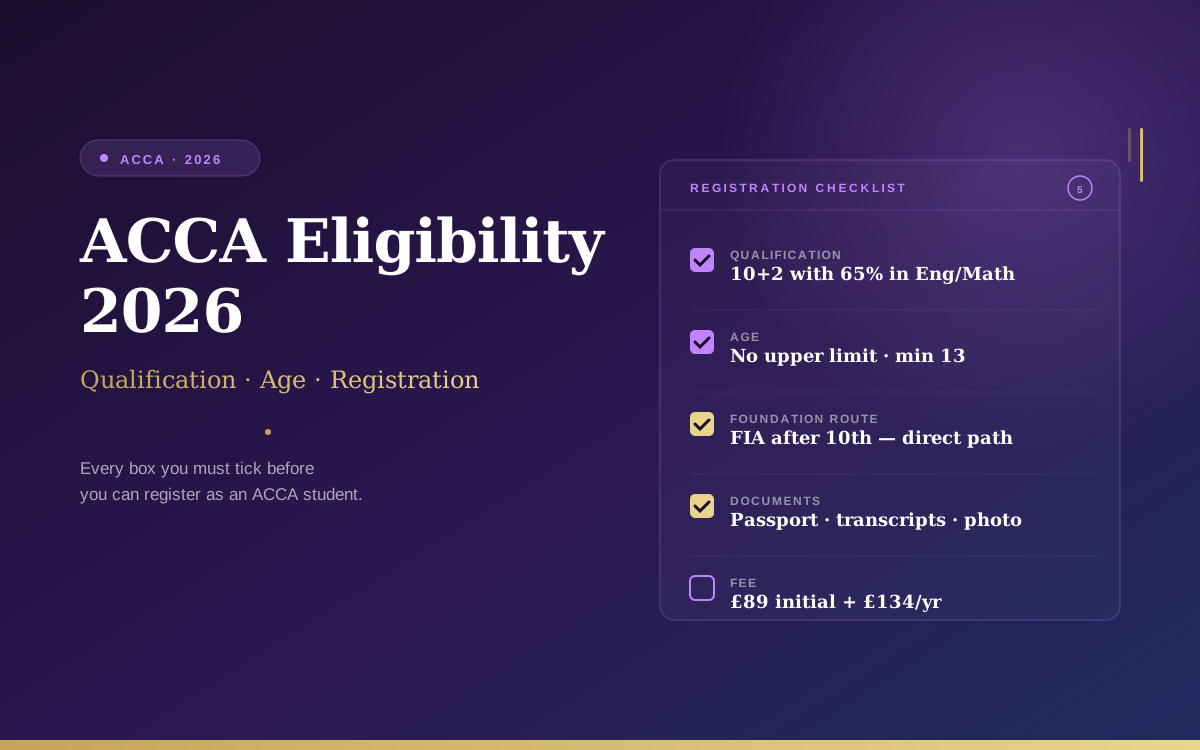
Who Can Do ACCA? A Quick Overview
The Association of Chartered Certified Accountants (ACCA) is one of the most accessible global accounting qualifications available today. Unlike many professional certifications that require a degree before you can even register, ACCA offers multiple entry points depending on your educational background — making it possible to begin your journey as early as after Class 10.
This comprehensive guide covers every aspect of ACCA eligibility in 2026 — the minimum educational qualifications required at each entry stage, age requirements, the Foundations in Accountancy (FIA) pathway for early starters, exemptions available for graduates and professional qualification holders, documentation needed for registration, and the step-by-step registration process. Whether you are a school student planning ahead, a commerce graduate exploring options, or a working professional seeking a career upgrade, this guide will clarify exactly how and when you can start your ACCA journey.
For a broader look at what the qualification covers, read our complete ACCA course details guide.
Key Takeaway
ACCA has no upper age limit and offers three entry points: after Class 10 (via FIA pathway), after Class 12 (direct entry), and after graduation (with exemptions). This flexibility makes ACCA one of the most accessible professional accounting qualifications globally.
ACCA After 10th: The FIA Pathway
One of the most distinctive features of ACCA is that you do not need to wait until graduation to start. If you have completed Class 10 (SSC, ICSE, or equivalent), you can enter the ACCA ecosystem through the Foundations in Accountancy (FIA) pathway.
The FIA route is specifically designed for students who want an early start in accounting and finance but have not yet completed their Class 12 or undergraduate education. It serves as a structured bridge programme that prepares you for the full ACCA qualification.
How the FIA Pathway Works
- Entry requirement: Completion of Class 10 (any board — CBSE, ICSE, State Board) with passing marks.
- Programme structure: FIA consists of introductory-level papers covering basic accounting principles, business fundamentals, and financial management foundations.
- Progression: After completing the FIA Diploma in Accounting and Business (DAB), you automatically qualify to enter the full ACCA qualification. You also receive exemptions from the first three ACCA Applied Knowledge papers (BT, MA, FA).
- Study duration: Most students complete the FIA programme in 6–12 months alongside their Class 11 and 12 studies.
This makes ACCA uniquely accessible compared to qualifications like CA or CFA, which require at least Class 12 or a degree respectively. For a detailed guide on beginning this early, read our ACCA after 10th guide.
Key Takeaway
The FIA pathway allows Class 10 students to enter the ACCA ecosystem immediately, giving them a 2–3 year head start over peers who wait until graduation to begin a professional qualification.
ACCA After 12th: Direct Entry
The most common entry point for Indian students is after completing Class 12 (10+2). If you have passed your Higher Secondary examination, you are eligible to register directly for the full ACCA qualification without going through the FIA pathway.
Eligibility Criteria for Direct Entry After 12th
- Minimum requirement: Passed Class 12 from a recognised board (CBSE, ISC, State Boards, IB, or equivalent international qualifications).
- Stream: While Commerce stream students have a natural advantage due to familiarity with accounting concepts, ACCA does not restrict entry by stream. Science and Arts students can also register directly after 12th.
- Minimum marks: ACCA does not mandate a specific percentage threshold in Class 12. However, you must have passed with the minimum marks required by your board.
- Subjects: No specific subject combination is required. Students from any academic background — whether they studied Accounts, Mathematics, or Humanities — can apply.
After registering, you begin with the Applied Knowledge level (3 papers), then progress to Applied Skills (6 papers), and finally the Strategic Professional level (4 papers) — totalling 13 exams. For a detailed roadmap, read our ACCA after 12th career guide.
ACCA After Graduation: Entry with Exemptions
Graduates from recognised universities enjoy the most advantageous entry into ACCA because they can claim exemptions from several papers based on their prior qualifications. This significantly reduces the number of exams required and shortens the overall completion timeline.
Eligibility for Graduates
- B.Com graduates: Eligible for direct entry with potential exemptions from 3–5 Applied Knowledge and Applied Skills papers, depending on the university and subjects studied.
- BBA / BMS graduates: Eligible for direct entry with 1–3 exemptions, typically in Business and Technology (BT) and Management Accounting (MA).
- MBA Finance graduates: Eligible with 2–4 exemptions, covering foundational accounting and management papers.
- CA Intermediate (both groups): Eligible with up to 5 exemptions from Applied Knowledge and Applied Skills papers.
- Fully qualified CA (ICAI): Eligible with up to 9 exemptions, needing to complete only the 4 Strategic Professional papers and the Ethics module.
- M.Com and other postgraduates: Exemptions vary based on institution and syllabus — typically 3–5 papers.
The exact number of exemptions depends on your specific university, the syllabus covered, and ACCA’s accreditation agreements. You can check your exemptions on the ACCA Exemptions Calculator. For a detailed breakdown, see our ACCA exemptions guide.
Age Requirements for ACCA
One of the most commonly asked questions about ACCA eligibility is whether there is an age limit. The answer is straightforward and encouraging.
No Upper Age Limit
ACCA has no upper age limit for registration. Whether you are 18, 35, or 50, you can register for ACCA as long as you meet the educational eligibility criteria. This makes ACCA particularly appealing for:
- Working professionals looking to switch careers or add a global credential to their profile, even in their 30s or 40s.
- Homemakers returning to the workforce who want a structured qualification pathway.
- Retired professionals seeking to transition into consulting, advisory, or academic roles.
Minimum Age Considerations
While ACCA does not specify a formal minimum age, the practical minimum is around 16–17 years — the age at which most students complete their Class 10 examination and become eligible through the FIA pathway. Students who complete Class 12 early (at 17–18) can enter the full ACCA qualification directly.
The key milestone is not age but educational qualification: you must have completed at least Class 10 to enter through FIA, or Class 12 to enter the full ACCA programme directly.
Foundations in Accountancy (FIA) Pathway Explained
The Foundations in Accountancy (FIA) programme is ACCA’s introductory-level qualification designed to build accounting and business knowledge from scratch. It is the recommended pathway for candidates who do not yet have Class 12 or a degree, though it is also available to anyone who wants a gentler introduction to the ACCA curriculum.
FIA Programme Structure
The FIA programme consists of several papers organised into three tiers:
- Introductory Certificate in Financial and Management Accounting: FAB (Accountant in Business), FMA (Management Accounting), and FFA (Financial Accounting) — these are the core papers that map directly to ACCA’s Applied Knowledge level.
- Intermediate Certificate in Financial and Management Accounting: Additional papers that deepen foundational knowledge.
- Diploma in Accounting and Business (DAB): The capstone qualification of the FIA programme. Completing the DAB qualifies you to enter the full ACCA qualification with exemptions from the three Applied Knowledge papers (BT, MA, FA).
Benefits of Starting with FIA
- Early start advantage: Begin building professional accounting credentials while still in school.
- Structured learning curve: FIA papers introduce concepts gradually, making the transition to full ACCA papers smoother.
- Cost efficiency: FIA exam fees are lower than full ACCA paper fees, reducing the initial financial commitment.
- Exemptions on completion: Completing the FIA Diploma grants exemptions from 3 ACCA papers, saving both time and money.
- Standalone value: The FIA Diploma is itself a recognised qualification that can support entry-level accounting and bookkeeping roles.
ACCA Eligibility Pathway Flowchart
Choose Your ACCA Entry Point
Exemptions by Qualification
One of the biggest advantages of entering ACCA as a graduate or professional qualification holder is the ability to claim exemptions from papers you have already covered in your prior education. Exemptions reduce the total number of exams, lower costs, and shorten your path to becoming an ACCA member.
Below is a summary of common exemptions available for Indian qualifications. Note that exemptions are subject to ACCA’s periodic review, and you should always verify your specific exemptions using the official ACCA Exemptions Calculator.
| Qualification | Typical Exemptions | Papers Remaining |
|---|---|---|
| Class 12 (any stream) | None | 13 papers |
| B.Com (recognised university) | BT, MA, FA (+ LW, TX in some cases) | 8–10 papers |
| BBA / BMS | BT, MA | 10–11 papers |
| M.Com | BT, MA, FA, LW, PM | 8–10 papers |
| MBA (Finance) | BT, MA, FA, FM | 9–11 papers |
| CA Intermediate (ICAI) | BT, MA, FA, LW, TX | 8 papers |
| CA Final (ICAI qualified) | BT, MA, FA, LW, PM, TX, FR, AA, FM | 4 papers |
| CMA India (Intermediate) | BT, MA, FA | 10 papers |
| FIA Diploma (DAB) | BT, MA, FA | 10 papers |
Important notes about exemptions:
- Each exemption carries a per-paper fee (currently around GBP 116 per exemption) that must be paid at the time of registration.
- Exemptions are granted only at the Applied Knowledge and Applied Skills levels. No exemptions are available for the Strategic Professional papers — every candidate must pass all four SP papers.
- The exemptions granted depend on the specific university and its accreditation with ACCA. Not all B.Com programmes qualify for the same exemptions.
- Exemptions do not guarantee knowledge — candidates who claim many exemptions should self-study the exempted topics as they form the foundation for higher-level papers.
For a comprehensive deep-dive, read our complete ACCA exemptions guide.
Documents Required for ACCA Registration
Before you begin the registration process, ensure you have the following documents ready. ACCA requires digital copies (scanned) uploaded through their online registration portal.
Mandatory Documents
- Proof of identity: A valid passport OR government-issued photo ID (Aadhaar card, PAN card, or driving licence for Indian students). A passport is recommended as it simplifies international exam scheduling.
- Educational qualification certificates:
- Class 10 marksheet (for FIA pathway entry)
- Class 12 marksheet and passing certificate (for direct entry after 12th)
- Degree certificate and all semester marksheets (for graduate entry with exemptions)
- CA Intermediate / Final passing certificate (if claiming CA-based exemptions)
- Passport-size photographs: Recent photographs meeting ACCA’s specifications (clear background, proper lighting).
- Proof of English proficiency: Required only if your prior education was not conducted in English. IELTS, TOEFL, or a certificate from your institution confirming English as the medium of instruction.
Additional Documents (If Applicable)
- Employment proof: If you are registering as a working professional and claiming work experience for the Practical Experience Requirement (PER).
- Name change documentation: If your name on educational documents differs from your current identity document (marriage certificate, gazette notification, etc.).
- Exemption-related transcripts: Detailed syllabi or transcripts from your university may be needed if ACCA requires verification for exemption claims.
International Eligibility
ACCA is a truly global qualification with no nationality or residency restrictions. Students from any country in the world can register for ACCA, making it one of the most internationally portable accounting credentials available.
Key Facts About International Eligibility
- Registration from anywhere: You can register through the ACCA Global website from any country. There is no requirement to live in the UK or any specific country.
- Exam centres in 180+ countries: ACCA exams are conducted at computer-based test centres worldwide, including multiple centres across India (Delhi, Mumbai, Bangalore, Chennai, Kolkata, Hyderabad, Pune, and more).
- Qualification equivalence: ACCA recognises educational qualifications from universities and boards across the world. Most nationally recognised high school completions and undergraduate degrees are accepted.
- Recognition across markets: ACCA is recognised in over 180 countries and has partnerships with over 7,700 employers globally. In India, ACCA members are employed at Big 4 firms, multinational banks, IT companies, and manufacturing conglomerates.
- Language: ACCA exams are conducted in English only. Candidates must be proficient in English to study for and attempt the exams.
Key Takeaway
ACCA is open to candidates from every country with no nationality restrictions. With exam centres in 180+ countries and recognition by 7,700+ employers globally, it is one of the most internationally portable accounting qualifications you can earn.
Registration Process Overview
Registering for ACCA is a fully online process that can be completed in about 30–45 minutes if you have all your documents ready. Here is the step-by-step process for 2026.
For a more detailed walkthrough, see our complete ACCA registration guide.
Step-by-Step ACCA Registration
- Visit the ACCA Global website: Navigate to accaglobal.com and click on “Register” or “Become a Student.”
- Choose your entry route: Select whether you are entering via the FIA pathway or the full ACCA qualification based on your educational background.
- Fill in personal details: Name (exactly as it appears on your ID), date of birth, nationality, contact information, and correspondence address.
- Upload educational documents: Scan and upload your marksheets, degree certificates, and ID proof. Ensure all documents are clear, legible, and in the accepted formats (PDF, JPEG).
- Claim exemptions (if applicable): During registration, you can indicate the exemptions you wish to claim. ACCA will verify your eligibility and confirm exemptions within 2–4 weeks.
- Pay the registration fee: The initial registration fee is approximately GBP 89 (around ₹9,000–10,000). Exemption fees are additional (GBP 116 per paper). Payment can be made via credit/debit card or online banking.
- Receive confirmation: Once your application is processed (typically 2–4 weeks), you will receive your ACCA student registration number and access to the myACCA portal, where you can book exams, access study resources, and track your progress.
Annual Subscription Fee
After registration, ACCA charges an annual subscription fee (approximately GBP 122 per year) to maintain your student status. This fee covers access to ACCA’s online resources, the myACCA portal, and student support services. The subscription must be maintained every year until you complete all exams and become a member.
Frequently Asked Questions
The minimum qualification to enter the ACCA qualification directly is passing Class 12 (10+2) with the required marks. However, students who have completed only Class 10 can enter through the Foundations in Accountancy (FIA) pathway, which provides a bridge to the full ACCA qualification after completing the FIA diploma exams.
There is no upper age limit for ACCA registration. You can register at any age as long as you meet the educational eligibility criteria. The minimum practical age is around 16–17 years, which is when students typically complete their Class 10 or 12 exams and become eligible to register through the FIA pathway or directly.
Yes, you can start your ACCA journey after completing Class 10 through the Foundations in Accountancy (FIA) pathway. The FIA programme includes introductory-level papers in accounting, business, and finance. After successfully completing the FIA Diploma in Accounting and Business, you can progress to the full ACCA qualification with exemptions from the first three Applied Knowledge papers.
The number of exemptions depends on your prior qualification. B.Com graduates can receive up to 3–5 exemptions. CA Intermediate students can get up to 5 exemptions. CA Final qualified candidates can receive up to 9 exemptions. MBA Finance graduates typically receive 2–4 exemptions. The exact number is determined by ACCA based on your specific university and syllabus.
Yes, ACCA is a global qualification open to students from any country. There are no nationality or residency restrictions. You can register from anywhere in the world through the ACCA Global website, choose exam centres in over 180 countries, and the qualification is recognised by employers across international markets.
You need proof of identity (valid passport or government-issued photo ID), educational qualification certificates (Class 12 marksheet, degree certificate, or FIA diploma), passport-size photographs, and proof of English proficiency if your education was not in English. All documents must be attested copies uploaded during the online registration process.
Yes, ACCA is widely recognised in India by Big 4 accounting firms (Deloitte, PwC, EY, KPMG), multinational corporations, banks, and financial institutions. ACCA members work across audit, taxation, financial reporting, advisory, and management accounting roles in India. The qualification is especially valued for roles requiring knowledge of International Financial Reporting Standards (IFRS).
Yes, CA students and qualified CAs receive significant exemptions. CA Intermediate (both groups) students can get up to 5 exemptions from ACCA Applied Knowledge and Applied Skills papers. Fully qualified Chartered Accountants from ICAI can receive up to 9 exemptions, needing to pass only 4 Strategic Professional papers plus the Ethics and Professional Skills module.