
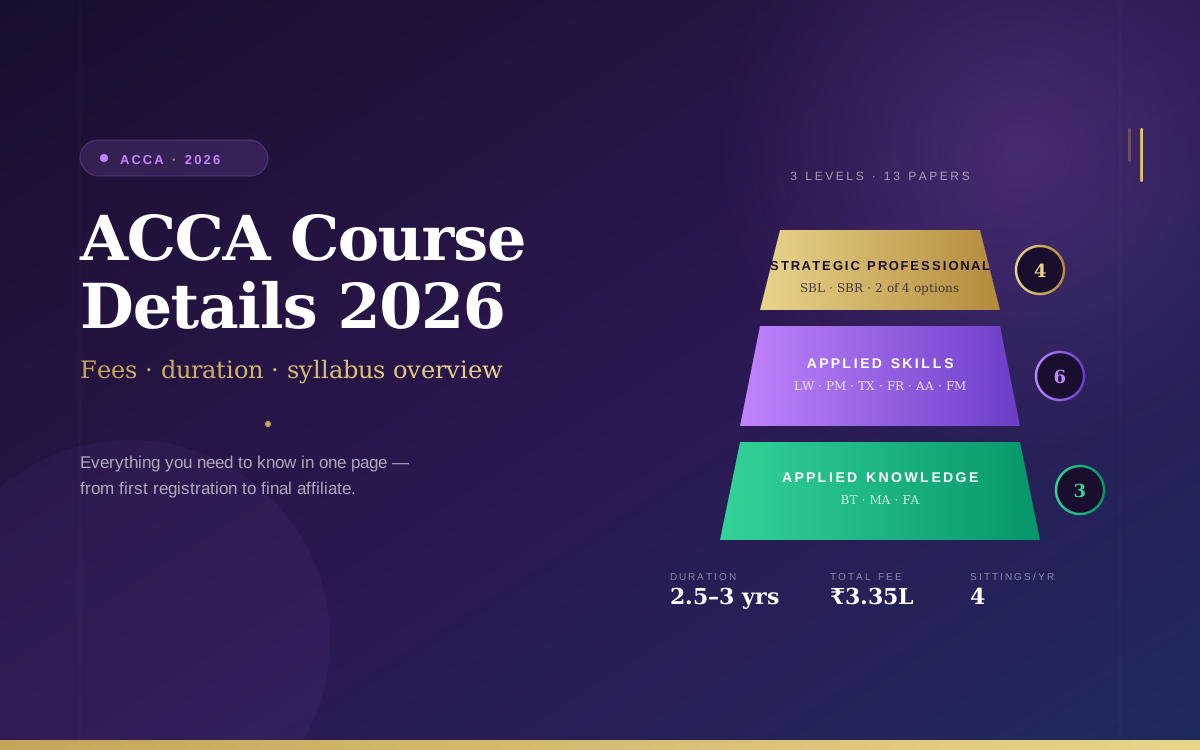
What Is ACCA? A Complete Course Overview for 2026
The Association of Chartered Certified Accountants (ACCA) is a globally recognised professional accounting qualification awarded by the UK-based ACCA body. With over 252,500 members and 526,000 students across 178 countries, ACCA is one of the largest and most respected accounting certifications in the world.
Unlike country-specific qualifications, ACCA is designed for international mobility. Whether you want to work in London, Dubai, Singapore, or Mumbai, the ACCA designation is recognised by employers, regulators, and audit firms globally. The qualification covers financial accounting, management accounting, taxation, audit, financial management, and strategic business leadership — giving you a comprehensive skill set that spans the full spectrum of finance and accounting roles.
The ACCA course consists of 13 exam papers across three progressive levels, an Ethics and Professional Skills Module, and 36 months of practical work experience. Most candidates complete the qualification in 2 to 4 years depending on exemptions, study pace, and whether they study full-time or alongside work.
ACCA Eligibility Criteria in 2026
ACCA has one of the most accessible entry requirements of any global accounting qualification. You do not need to be a graduate to register. The eligibility criteria are straightforward:
- After Class 12 (10+2): You can register for ACCA if you have passed your Class 12 or equivalent examination with a minimum of 65% in Mathematics/Accounts and 50% overall across five subjects (including English). This makes ACCA one of the few professional qualifications you can begin immediately after school.
- After Graduation: Graduates from B.Com, BBA, BAF, BMS, M.Com, MBA, and CA Intermediate backgrounds are all eligible. Graduates typically receive exemptions from some papers (covered below).
- Mature Applicant Route: If you are 21 or older but do not meet the standard academic requirements, you can apply through the ACCA Foundation Diploma route (FIA) and transition into the main ACCA qualification.
There is no upper age limit for registering with ACCA, and you have a maximum of 10 years from your initial registration to complete all exams. Working professionals, career changers, and fresh graduates can all pursue ACCA at their own pace.
All 13 ACCA Papers: Complete Syllabus Breakdown
The ACCA qualification is divided into three levels. Each level builds on the knowledge and skills developed in the previous one. Here is a detailed breakdown of every paper, including what each exam tests and the format you can expect.
Level 1: Applied Knowledge (3 Papers)
The Applied Knowledge level introduces foundational accounting and business concepts. These papers are available as on-demand computer-based exams (CBEs) at any Pearson VUE or ACCA-approved exam centre throughout the year. Each paper is 2 hours long and consists entirely of multiple-choice and multi-task questions.
| Paper Code | Paper Name | What It Covers | Duration |
|---|---|---|---|
| BT | Business and Technology | Business organisation, corporate governance, IT systems, stakeholder management, and professional ethics in a business context | 2 hrs |
| MA | Management Accounting | Cost classification, budgeting, variance analysis, cost-volume-profit analysis, and decision-making techniques using management accounting data | 2 hrs |
| FA | Financial Accounting | Double-entry bookkeeping, preparation of financial statements for sole traders and companies, accounting standards, and the conceptual framework | 2 hrs |
Level 2: Applied Skills (6 Papers)
The Applied Skills level is the most exam-heavy stage of the ACCA qualification. These six papers are held four times a year (March, June, September, and December) and combine objective-format testing with constructed response (written) questions. Each exam is 3 hours long.
| Paper Code | Paper Name | What It Covers | Duration |
|---|---|---|---|
| LW | Corporate and Business Law | Legal system, contract law, employment law, company law, and corporate governance. Available as on-demand CBE (MCQ only) or session-based exam. | 2 hrs |
| PM | Performance Management | Advanced costing techniques, decision-making, budgetary control, performance measurement, and transfer pricing | 3 hrs |
| TX | Taxation | Income tax, corporation tax, capital gains tax, inheritance tax, VAT, and national insurance — rules vary by country variant selected | 3 hrs |
| FR | Financial Reporting | Preparation and analysis of financial statements using IFRS, group accounts, interpretation of financial statements, and regulatory framework | 3 hrs |
| AA | Audit and Assurance | Audit planning, risk assessment, internal controls, audit evidence, reporting, and professional ethics in audit engagements | 3 hrs |
| FM | Financial Management | Working capital management, investment appraisal, business valuation, cost of capital, and risk management using financial instruments | 3 hrs |
Level 3: Strategic Professional (4 Papers)
The Strategic Professional level is the final and most challenging stage. It consists of two mandatory Essentials papers and two Options papers that you choose based on your career interests. These exams test higher-order skills — strategic thinking, professional judgement, and the ability to advise senior management on complex business scenarios.
| Paper Code | Paper Name | What It Covers | Duration |
|---|---|---|---|
| Essentials (Both Mandatory) | |||
| SBL | Strategic Business Leader | Leadership, governance, strategy formulation, risk management, innovation, and integrated reporting — based on a pre-seen case study | 4 hrs |
| SBR | Strategic Business Reporting | Advanced financial reporting, IFRS application, ethical implications of reporting, current reporting issues, and analysis of complex transactions | 3 hrs 15 min |
| Options (Choose Any 2 of 4) | |||
| AFM | Advanced Financial Management | Advanced investment appraisal, mergers and acquisitions, corporate reconstruction, treasury management, and international financial management | 3 hrs 15 min |
| APM | Advanced Performance Management | Strategic performance measurement, external factors affecting performance, strategic planning models, and performance evaluation methods | 3 hrs 15 min |
| ATX | Advanced Taxation | Complex personal and corporate tax planning, cross-border taxation, inheritance tax planning, and ethical considerations in tax advisory | 3 hrs 15 min |
| AAA | Advanced Audit and Assurance | Complex audit engagements, ethical dilemmas, quality control, professional liability, and reporting on specialised audits | 3 hrs 15 min |
ACCA Exam Pattern: Computer-Based Examination (CBE) Format
All 13 ACCA papers are now delivered as computer-based examinations (CBEs). There are no pen-and-paper exams remaining in the ACCA qualification as of 2026. However, the format and question types differ by level:
| Level | Question Types | Exam Schedule | Pass Mark |
|---|---|---|---|
| Applied Knowledge (BT, MA, FA) | MCQs, multi-task questions (MTQs) | On-demand (any time at Pearson VUE centres) | 50% |
| LW (Corporate Law) | MCQs, multi-task questions (MTQs) | On-demand or session-based | 50% |
| Applied Skills (PM, TX, FR, AA, FM) | MCQs (Section A) + Constructed response/written (Section B & C) | Session-based: March, June, September, December | 50% |
| Strategic Professional (SBL, SBR, Options) | Constructed response only — scenario-based questions requiring written analysis | Session-based: March, June, September, December | 50% |
The pass mark for every ACCA paper is 50 out of 100. There is no negative marking. For papers with multiple sections, marks are aggregated — you do not need to pass each section individually. ACCA also provides instant provisional results for on-demand Applied Knowledge papers, while session-based results are released approximately 6-8 weeks after the exam sitting.
ACCA Course Duration: How Long Does It Take?
The time required to complete the ACCA qualification depends on your starting point, the number of exemptions you receive, and your study pace. Here are realistic timelines based on different scenarios:
| Starting Point | Papers to Clear | Expected Duration |
|---|---|---|
| After Class 12 (no exemptions) | All 13 papers | 3 to 4 years |
| B.Com graduate (with exemptions) | 9 to 10 papers | 2 to 3 years |
| CA Intermediate cleared | 5 to 8 papers | 1.5 to 2.5 years |
| MBA Finance graduate | 8 to 10 papers | 2 to 3 years |
| Full-time focused study (no exemptions) | All 13 papers | 2 to 2.5 years |
ACCA allows you a maximum of 10 years from initial registration to complete all exams. Exam sessions are held four times a year for session-based papers, and Applied Knowledge papers can be taken on demand. Most coaching institutes — including QuintEdge — recommend attempting two papers per session for optimal pass rates.
ACCA Course Fees in India (2026 Fee Structure in INR)
ACCA fees are paid in British Pounds (GBP) directly to ACCA Global. Below is a comprehensive breakdown of all fees converted to approximate INR values (at roughly 1 GBP = 107 INR as of early 2026). Note that exchange rate fluctuations can affect the final amount.
| Fee Component | Amount (GBP) | Approximate INR |
|---|---|---|
| Initial Registration Fee | 89 | 9,500 |
| Annual Subscription Fee | 122/year | 13,100/year |
| Applied Knowledge Exams (per paper) | 137 | 14,700 |
| Applied Skills Exams (per paper) | 183 | 19,600 |
| Strategic Professional — Essentials (per paper) | 257 | 27,500 |
| Strategic Professional — Options (per paper) | 257 | 27,500 |
| Ethics & Professional Skills Module (EPSM) | 70 | 7,500 |
| Exemption Fee (per paper exempted) | 137 | 14,700 |
| Total Exam Fees (all 13 papers, no exemptions) | ~2,675 | ~2,86,000 |
| Total Including Registration, Subscription (3 yrs), EPSM | ~3,200 | ~3,42,000 |
If you opt for coaching classes, the additional tuition cost typically ranges from INR 1,50,000 to INR 3,50,000 depending on the institute, mode (online or offline), and whether you enrol for individual papers or a full-course package. QuintEdge offers competitive pricing with flexible payment plans.
Important fee tips: ACCA charges higher late entry fees if you register for session-based exams after the standard deadline. Early registration can save you 10-15% per paper. Additionally, re-sitting a paper costs the same as the original exam fee — making first-attempt preparation crucial.
ACCA Exemptions: Papers You Can Skip
One of ACCA's biggest advantages is its generous exemption policy. Depending on your prior qualifications, you may be exempt from up to 9 of the 13 papers — allowing you to fast-track your qualification significantly. Below is a summary of exemptions available for common Indian qualifications:
| Qualification | Typical Exemptions | Papers Remaining |
|---|---|---|
| B.Com (from ACCA-accredited university) | BT, MA, FA, LW (up to 4 papers) | 9 papers |
| B.Com (Honours) / M.Com | BT, MA, FA, LW, TX, FR (up to 6 papers) | 7 papers |
| CA Intermediate (ICAI) | BT, MA, FA, LW, TX, FR, AA, FM (up to 8 papers) | 5 papers |
| CA Final (ICAI) | Up to 9 Applied Knowledge & Skills papers | 4 papers |
| CMA India Intermediate | BT, MA, FA (up to 3 papers) | 10 papers |
| MBA Finance | BT, MA, FA, LW (up to 4 papers) | 9 papers |
Exemptions are not automatic — you must apply and pay the exemption fee (currently 137 GBP per paper) during registration. The exact exemptions depend on your specific university and the accreditation agreement it has with ACCA Global. You can check your eligibility using the official ACCA Exemption Calculator on their website.
Career Outcomes and Salary Prospects After ACCA
ACCA opens doors to a wide range of finance and accounting roles across industries. The qualification is particularly valued in Big 4 accounting firms, multinational corporations, banking and financial services, and consulting firms. Here are the most common career paths and salary ranges for ACCA members:
The salary range for ACCA-qualified professionals in India is broad because it depends heavily on experience, industry, and location. Entry-level ACCA affiliates in Big 4 firms typically start at 6 to 10 LPA, while those with 5-8 years of experience regularly earn 15 to 30 LPA. Senior roles such as Finance Director or CFO can command 40 LPA and above, particularly in MNCs and financial services.
Top employers of ACCA members in India include Deloitte, PwC, EY, KPMG, JPMorgan, HSBC, Standard Chartered, Infosys BPM, Accenture, and Amazon. ACCA's global recognition also enables international career opportunities in the UK, UAE, Singapore, Australia, and Canada.
ACCA vs CA (India): A Quick Comparison
The ACCA vs CA debate is one of the most common questions among Indian commerce students. Both are prestigious qualifications, but they serve different career paths and have distinct advantages. Here is a concise comparison:
| Parameter | ACCA | CA (ICAI) |
|---|---|---|
| Awarding Body | ACCA (UK-based, global) | ICAI (India-specific) |
| Total Papers | 13 papers across 3 levels | Approximately 20 papers across 3 groups |
| Global Recognition | 178 countries worldwide | Primarily India, MoUs with some countries |
| Typical Duration | 2-4 years | 4-5 years (including articleship) |
| Articleship Requirement | No mandatory articleship; 36-month PER (can be done alongside any job) | Mandatory 3-year articleship under a practising CA |
| Eligibility | After Class 12 (65% in Maths/Accounts) | After Class 12 (any stream) |
| Exam Pattern | 100% computer-based (CBE) | Pen-and-paper + some CBE at Foundation |
| Signing Rights in India | No (requires CA for statutory audits in India) | Yes (statutory audit signing authority) |
| Best For | Global careers, MNC roles, international finance | Indian practice, statutory audit, taxation practice |
| Starting Salary (India) | 6-10 LPA | 7-12 LPA |
The bottom line: if your goal is to work internationally or in MNCs, ACCA is the stronger choice. If you want to practice as a chartered accountant in India with statutory audit signing rights, CA from ICAI is essential. Many ambitious professionals pursue both — clearing CA and then adding ACCA with exemptions to unlock global mobility.
Frequently Asked Questions About ACCA Course Details
The total cost of completing ACCA from India — including registration, annual subscription (for 3 years), all 13 exam fees, and the Ethics module — is approximately INR 3,40,000 to 3,50,000 paid directly to ACCA Global. If you add coaching institute fees (INR 1,50,000 to 3,50,000 depending on the provider), the all-in cost ranges from INR 5,00,000 to 7,00,000. Exemptions reduce the exam fee portion since you pay a lower exemption fee instead of the full exam fee, but you still pay per exempted paper.
Yes. ACCA is one of the few global professional qualifications that accepts students directly after Class 12. You need a minimum of 65% in Mathematics or Accounts and 50% overall across five subjects including English. Starting after Class 12 means you attempt all 13 papers (no exemptions), but you can simultaneously pursue a BSc degree from Oxford Brookes University through ACCA's partnership — giving you a degree and a professional qualification in parallel.
B.Com graduates from ACCA-accredited Indian universities typically receive 3 to 6 exemptions depending on their university and syllabus. Most commonly, exemptions are granted for BT, MA, FA (Applied Knowledge), and sometimes LW, TX, and FR (Applied Skills). The exact count varies by university — you can check your specific exemptions using the ACCA Exemption Calculator on ACCA Global's website.
Yes, ACCA is widely recognised in India by Big 4 firms (Deloitte, PwC, EY, KPMG), multinational corporations, banks, and KPOs. While ACCA does not grant statutory audit signing rights in India (that requires ICAI CA), it is highly valued for roles in financial reporting, management accounting, internal audit, advisory, and corporate finance. Many Indian employers specifically seek ACCA-qualified professionals for roles that require IFRS knowledge and international financial reporting expertise.
The pass mark for all ACCA papers is 50 out of 100. Global pass rates vary by paper: Applied Knowledge papers have pass rates of approximately 75-85%, Applied Skills papers range from 45-65%, and Strategic Professional papers are typically 30-50%. The lower pass rates at higher levels reflect the increasing difficulty and the shift from objective-format to fully written exams. With structured coaching and consistent preparation, candidates can significantly outperform these averages.
Absolutely. ACCA is specifically designed for flexibility. Unlike CA (which requires a mandatory 3-year articleship), ACCA lets you study at your own pace while working in any finance or accounting role. The Practical Experience Requirement (PER) can be completed in any relevant job — it does not need to be under a specific mentor or firm type. Most ACCA students work full-time and study for exams alongside their job, typically attempting 2 papers per quarterly session.
ACCA has a partnership with Oxford Brookes University (UK) that allows students to earn a BSc (Hons) in Applied Accounting after completing the first 9 papers (Applied Knowledge + Applied Skills) and submitting a Research and Analysis Project (RAP). Additionally, upon completing all ACCA exams, you can earn an MSc in Professional Accountancy from the University of London. Both degrees are internationally recognised and add significant value to your resume — particularly if you started ACCA after Class 12 without a traditional degree.
Applied Knowledge papers (BT, MA, FA) and LW are available on demand throughout the year at Pearson VUE exam centres — you can book and sit for them on almost any working day. Applied Skills papers (PM, TX, FR, AA, FM) and Strategic Professional papers (SBL, SBR, and Options) are offered in four exam windows per year: March, June, September, and December. There is no formal limit on how many papers you attempt per session, but most coaches recommend a maximum of two session-based papers per sitting.