
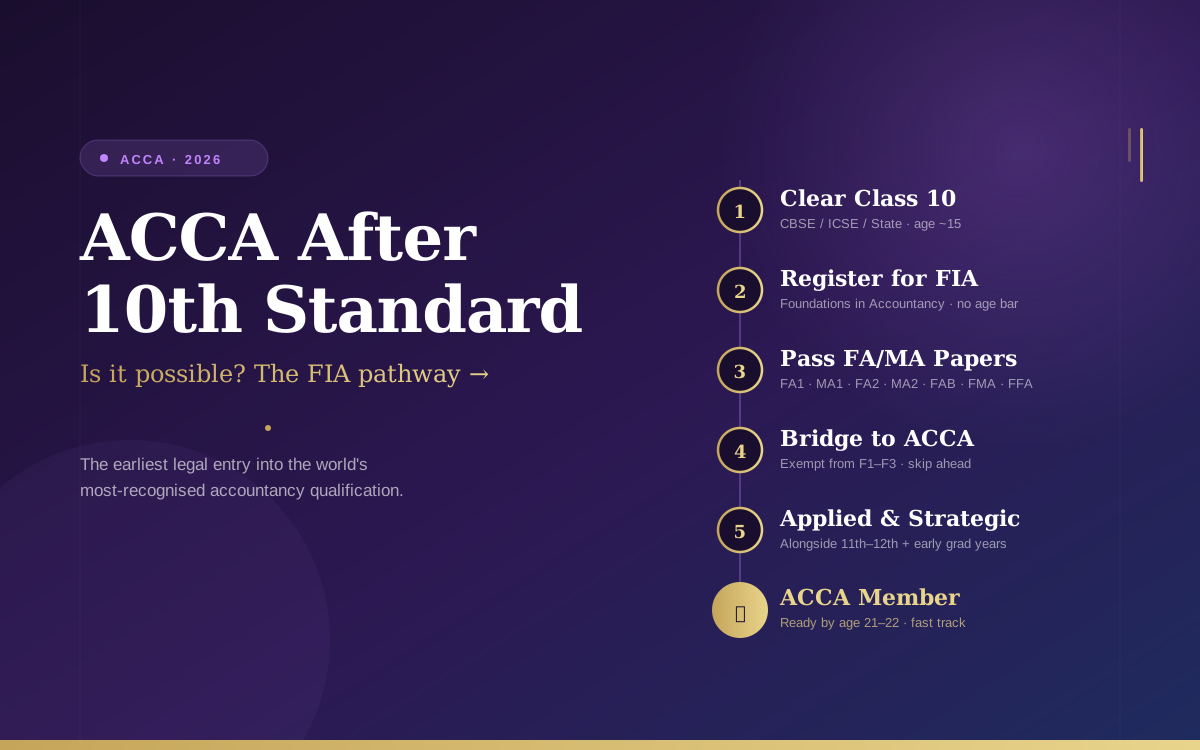
Can You Start ACCA After 10th? The Short Answer
If you are a student who has just completed 10th standard and is passionate about accounting and finance, you may be wondering whether it is possible to begin pursuing the ACCA qualification after 10th class. The short answer: yes, it is possible — but not through the direct ACCA route.
The Association of Chartered Certified Accountants (ACCA) requires candidates to meet certain educational thresholds before registering for the main ACCA qualification. A 10th pass certificate alone does not meet those thresholds. However, ACCA has designed a dedicated entry-level pathway called the Foundations in Accountancy (FIA) programme specifically for students who want to start their accounting journey early — even right after completing their 10th class.
The FIA pathway acts as a bridge. It prepares you academically for the ACCA qualification while giving you foundational accounting knowledge. Once you complete FIA, you transition directly into the ACCA programme with exemptions from the first three papers. This means you lose no time — every exam you pass in FIA counts towards your eventual ACCA membership.
This guide provides a complete, India-focused roadmap for students considering ACCA after 10th — covering the FIA pathway, eligibility, step-by-step progression, realistic timelines, costs, and whether starting early is genuinely worth it. For a broader overview of the qualification, see our complete ACCA course details guide.
Key Takeaway
You cannot register for the main ACCA qualification directly after 10th. But you can start the FIA (Foundations in Accountancy) pathway immediately after 10th, which feeds directly into ACCA with exemptions. Starting early gives you a 2-year head start over peers who wait until graduation.
What Is FIA (Foundations in Accountancy)?
The Foundations in Accountancy (FIA) programme is an entry-level qualification designed by ACCA for students who do not yet meet the educational requirements for the full ACCA qualification. It is globally recognised and serves as the official stepping stone into ACCA for younger students, career changers, and those from non-commerce backgrounds.
FIA Structure: 4 Papers
The FIA programme at the Diploma level (which is the level that provides direct entry into ACCA) consists of four papers:
- FAB — Accountant in Business: Covers the business environment, organisational structure, governance, and the role of accounting in business decision-making. This paper builds your understanding of how businesses operate and where accountants fit into the picture.
- FMA — Management Accounting: Introduces cost classification, budgeting, variance analysis, and performance measurement. You learn how internal accounting information helps managers make better operational decisions.
- FFA — Financial Accounting: Covers the fundamentals of double-entry bookkeeping, preparing financial statements (income statement, balance sheet, cash flow statement), and understanding accounting standards. This is the most technically demanding FIA paper.
- Foundations in Professionalism (FiP): An online interactive module that introduces professional ethics, accountability, and the responsibilities of an accounting professional. It is not a traditional exam but a mandatory completion requirement.
Each of the three exam-based papers (FAB, FMA, FFA) is a two-hour computer-based exam consisting of objective-type questions. The pass mark is 50%. Exams are available on-demand at approved computer-based exam centres throughout India, so you can schedule them at your convenience rather than waiting for fixed exam windows.
How FIA Leads to ACCA
This is the critical advantage of the FIA pathway: completing the FIA Diploma papers gives you automatic exemptions from the three ACCA Applied Knowledge papers (BT, MA, and FA). These ACCA papers cover identical content to the FIA papers you have already passed. In effect, by completing FIA, you enter the ACCA qualification at the Applied Skills level — skipping the first tier entirely.
Upon completing FIA, you also earn the ACCA Diploma in Accounting and Business — a standalone qualification that is itself globally recognised and can be listed on your CV even before you complete the full ACCA programme.
Key Takeaway
FIA consists of 3 exam papers + 1 ethics module. Completing FIA earns you the Diploma in Accounting and Business and provides exemptions from 3 ACCA papers. You enter ACCA directly at the Applied Skills level — no wasted effort.
Eligibility for 10th Pass Students
One of the most common concerns among students and parents is whether a 10th pass certificate is sufficient to begin the FIA programme. Here is the clear eligibility breakdown.
FIA Eligibility (Entry After 10th)
- Minimum education: Completion of 10th standard (SSC / ICSE / CBSE or equivalent board examination) is sufficient to register for the FIA programme.
- No minimum percentage: There is no minimum marks or grade requirement. If you have passed 10th class, you are eligible.
- No age restriction: There is no minimum or maximum age limit. Students as young as 15–16 can begin FIA.
- No subject restriction: You do not need to have studied commerce or accounting in school. Students from science, arts, or any stream can register.
- Registration: You register directly on the ACCA Global website for the FIA programme.
ACCA Main Qualification Eligibility (For Comparison)
- Minimum education: Completion of 12th standard (HSC / ISC / CBSE) with specific subject and percentage requirements, OR a completed bachelor’s degree, OR completion of the FIA pathway.
- Typical requirement for direct entry: Most Indian students entering ACCA directly need to have completed 12th with a minimum of 65% in Maths/Accounts and 50% overall, or a relevant graduation degree.
This comparison makes it clear: if you have only completed 10th class, FIA is your only entry point into the ACCA ecosystem. But it is a well-designed, legitimate, and efficient entry point. For full eligibility details across all entry routes, read our ACCA after 12th guide.
Step-by-Step Roadmap: 10th to ACCA Membership
Here is the complete pathway from passing your 10th board examination to becoming a fully qualified ACCA member. This roadmap assumes you start immediately after 10th and pursue the qualification with consistent effort.
ACCA After 10th: Complete Pathway Flowchart
Detailed Step Breakdown
- Step 1 — Complete 10th Standard: Pass your board examination from any recognised Indian board (CBSE, ICSE, State Board). No minimum percentage or specific subject requirements.
- Step 2 — Register for and Complete FIA: Register on the ACCA Global website for the FIA programme. Prepare for and pass the three FIA Diploma papers (FAB, FMA, FFA) and complete the Foundations in Professionalism module. This typically takes 6–12 months.
- Step 3 — Enter ACCA at Applied Skills Level: With FIA complete, you receive exemptions from the three Applied Knowledge papers and register for the full ACCA qualification. Begin with the six Applied Skills papers: Corporate and Business Law (LW), Performance Management (PM), Taxation (TX), Financial Reporting (FR), Audit and Assurance (AA), and Financial Management (FM). This stage takes 1.5–2 years.
- Step 4 — Complete ACCA Strategic Professional: Pass the four Strategic Professional papers: Strategic Business Leader (SBL), Strategic Business Reporting (SBR), and two optional papers from a choice of four (Advanced Financial Management, Advanced Performance Management, Advanced Taxation, Advanced Audit and Assurance). This takes 1–1.5 years.
- Step 5 — Practical Experience Requirement (PER): Complete 36 months of relevant practical work experience. This can be accumulated alongside your studies — many students begin internships or part-time roles during the Applied Skills stage itself.
For more on how long each stage takes, see our detailed ACCA duration guide.
Realistic Timeline: 10th to ACCA Membership
While it is theoretically possible to complete the entire journey in under 4 years, a realistic timeline for most Indian students starting after 10th is 5–6 years. Here is why.
| Stage | Papers | Best Case | Realistic |
|---|---|---|---|
| FIA Diploma | 3 exams + ethics | 6 months | 9–12 months |
| Applied Skills | 6 papers | 1 year | 1.5–2 years |
| Strategic Professional | 4 papers | 9 months | 1–1.5 years |
| Practical Experience (PER) | 36 months | Overlapping | Overlapping |
| Total Journey | 13 exams | ~3.5 years | 5–6 years |
The realistic timeline accounts for the fact that you will likely be studying for your 11th, 12th, and possibly a graduation degree simultaneously. It also accounts for the occasional exam retake — ACCA pass rates average between 40–65% depending on the paper, so not every candidate clears every paper on the first attempt.
The critical point is this: even at a 5–6 year timeline, a student who starts after 10th can become a fully qualified ACCA member by age 21–22. Most peers who start ACCA after graduation will be 24–26 by the time they complete the qualification. That 3–4 year head start compounds significantly over a career.
Cost Breakdown: ACCA After 10th (Full Journey)
Understanding the financial commitment is essential for students and parents planning this journey. Here is a comprehensive cost breakdown in Indian Rupees for the entire pathway from FIA through ACCA completion.
| Cost Component | Amount (INR Approx.) |
|---|---|
| FIA Registration Fee | ₹6,500–8,000 |
| FIA Exam Fees (3 papers) | ₹15,000–25,000 |
| ACCA Initial Registration Fee | ₹7,500–9,000 |
| ACCA Annual Subscription (5–6 years) | ₹80,000–1,20,000 |
| ACCA Exam Fees — Applied Skills (6 papers) | ₹75,000–1,10,000 |
| ACCA Exam Fees — Strategic Professional (4 papers) | ₹75,000–1,10,000 |
| Study Materials (self-study or approved) | ₹30,000–60,000 |
| Coaching Fees (optional but recommended) | ₹80,000–1,50,000 |
| Ethics & Professional Skills Module | ₹8,000–10,000 |
| Total All-In Cost | ₹3,50,000–5,50,000 |
A few important notes on costs:
- Early registration discounts: ACCA offers significantly lower exam fees for early registration (typically 5–6 weeks before the exam deadline). Always register early to save 20–30% on exam fees.
- Retake costs: If you need to retake a paper, you pay the exam fee again. Budget for 1–2 retakes across the full journey to be safe.
- Coaching is optional: You can self-study using ACCA’s approved learning partners and free resources. However, professional coaching significantly improves pass rates, especially for the more demanding Applied Skills and Strategic Professional papers.
- Compared to CA: The total ACCA cost is comparable to the Indian CA qualification when you factor in coaching, but ACCA offers global portability that CA does not.
Key Takeaway
The total cost of ACCA after 10th ranges from ₹3.5 to 5.5 lakh spread over 5–6 years. This is manageable at roughly ₹60,000–90,000 per year — comparable to the annual tuition of a decent B.Com programme, but with a globally recognised professional qualification at the end.
Advantages of Starting ACCA After 10th
Starting your ACCA journey at age 15–16 rather than waiting until 18 (after 12th) or 21–22 (after graduation) offers several compounding advantages that are often underestimated.
1. Age Advantage in the Job Market
A student who starts ACCA after 10th can realistically become a fully qualified ACCA member by age 21–22. This means you enter the professional job market with a globally recognised qualification at an age when most peers are still finishing their undergraduate degrees. In accounting and finance, early qualification translates directly into earlier career progression, higher lifetime earnings, and more time to accumulate senior-level experience.
2. Compounding Professional Experience
ACCA requires 36 months of practical experience for full membership. Starting early means you can begin accumulating this experience through internships and part-time roles during your late teens, running parallel to your academic studies. By the time you graduate from college (if you choose to pursue a degree simultaneously), you may already have 2–3 years of relevant work experience — a significant advantage in hiring.
3. Stronger Foundation for Higher Studies
Completing FIA and the early ACCA papers gives you a rock-solid foundation in accounting, business law, taxation, and financial management. This foundation makes your 11th, 12th, and undergraduate commerce studies significantly easier. Many ACCA students report that their school and college exams feel straightforward after preparing for ACCA-level content.
4. Global Mobility from a Young Age
ACCA is recognised in over 180 countries. Completing the qualification early opens doors to international opportunities — audit firms, multinational corporations, and Big 4 offices across the UK, Middle East, Singapore, Australia, and beyond — at an age when you still have the flexibility and energy to relocate and build a global career.
5. Lower Opportunity Cost
When you start ACCA during school years (alongside 11th and 12th), the opportunity cost is minimal. You are not sacrificing a full-time job or a significant income source. Contrast this with a working professional who must study for ACCA exams while managing a demanding job — the time pressure and trade-offs are considerably higher.
ACCA After 10th vs After 12th: Which Is Better?
This is the most debated question among students and parents considering the ACCA pathway. Both entry points have legitimate advantages, and the right choice depends on your personal circumstances.
| Factor | After 10th (FIA Route) | After 12th (Direct Entry) |
|---|---|---|
| Entry Pathway | FIA → ACCA Applied Skills | Direct ACCA Applied Knowledge |
| Additional Exams | 3 FIA papers (replace 3 AK papers) | None — start with AK directly |
| Time to Completion | 5–6 years from 10th | 3.5–5 years from 12th |
| Age at Qualification | 21–22 years | 21–23 years |
| Academic Load | Higher (ACCA + school simultaneously) | Lower (ACCA after boards) |
| Financial Commitment | Slightly higher (longer subscription) | Slightly lower |
| Career Head Start | 1–2 years earlier | Standard timeline |
| Best For | Highly motivated, career-certain students | Students wanting to finish boards first |
When Starting After 10th Makes Sense
- You are certain about a career in accounting and finance and do not need more time to explore options.
- You are academically strong and can manage parallel studies without compromising your school performance.
- You have family support (financial and motivational) for a long-term professional qualification journey.
- You want to maximise your career head start and are willing to put in extra hours during your school years.
When Waiting Until 12th Makes Sense
- You are not yet certain about accounting as a career and want to explore other options during 11th and 12th.
- Your board exam performance is a priority, and you do not want any additional academic commitments.
- You want to enter ACCA directly without the FIA step and prefer a more streamlined qualification path.
- You want to focus on competitive exams (like CA Foundation or university entrance exams) during 11th and 12th.
For students who choose to wait, our ACCA after 12th guide provides a complete roadmap for that pathway.
Combining ACCA With Regular School and College Studies
One of the most practical concerns for students starting ACCA after 10th is time management. How do you balance ACCA preparation with your 11th, 12th, or undergraduate studies? Here is a realistic framework.
During 11th Class (Age 16–17)
Focus on completing the three FIA papers. Allocate 8–10 hours per week to FIA preparation. The FIA content is fundamental and does not require extensive prior knowledge, so the study load is manageable alongside school. If you are in the commerce stream, you will find significant overlap between your school curriculum and FIA content — particularly in accounting and business studies.
During 12th Class (Age 17–18)
By this time, you should have completed FIA and transitioned into ACCA Applied Skills. Begin with 1–2 Applied Skills papers while prioritising your board exam preparation. During the months leading up to board exams (typically February–March), reduce ACCA study and focus entirely on boards. Resume ACCA preparation immediately after boards for the June exam session.
During Undergraduate Studies (Age 18–21)
This is where the ACCA journey accelerates. With board exams behind you, you can dedicate more time to clearing the remaining Applied Skills papers and moving into Strategic Professional. Many students complete 3–4 ACCA papers per year during their undergraduate studies. If you are pursuing a B.Com degree, the subject overlap is substantial and mutually reinforcing.
Practical Study Schedule
- Weekdays: 1–2 hours of ACCA study after school/college (focus on reading and note-taking).
- Weekends: 3–4 hours per day (focus on practice questions and mock exams).
- Exam preparation months: Increase to 15–20 hours per week for 6–8 weeks before each ACCA exam session.
- Board exam months: Pause ACCA and focus entirely on school exams.
Key Takeaway
Combining ACCA with regular studies is challenging but entirely feasible with disciplined time management. The key is to plan your ACCA exam attempts around your school and college exam schedules, not against them. Start FIA during 11th, transition to Applied Skills during 12th, and accelerate during graduation.
Success Stories: Students Who Started Early
While individual results vary, starting ACCA early has produced remarkable outcomes for motivated Indian students. Here are representative profiles that illustrate what is possible.
Profile 1: Commerce Student from Delhi
Started FIA at age 16 immediately after 10th board exams. Completed all three FIA papers within 8 months while studying in 11th class (Commerce stream, CBSE). Transitioned to ACCA Applied Skills during 12th. Cleared 4 Applied Skills papers by the end of her first year of B.Com. Completed the full ACCA qualification at age 21, securing a position at a Big 4 audit firm before her final B.Com semester. She attributes her early start to giving her the confidence and knowledge that made both college exams and job interviews significantly easier.
Profile 2: Science Student from Mumbai
Despite being in the science stream, registered for FIA after 10th with an interest in finance. Completed FIA during 11th class and switched to B.Com after 12th to align his degree with his ACCA pathway. The FIA foundation made the transition from science to commerce seamless. Completed ACCA at age 22 and now works in management consulting, leveraging both his analytical science background and ACCA qualification.
Profile 3: Small-Town Student from Rajasthan
From a tier-3 city with limited access to coaching centres, enrolled in FIA after 10th and studied entirely through online resources and ACCA’s approved content partner materials. Passed all FIA papers in her first attempt. Despite slower progress during Applied Skills (due to limited coaching access), completed the full ACCA qualification by age 23 and secured a role at a multinational accounting firm in Gurgaon. Her story demonstrates that geographic location is not a barrier — the ACCA’s on-demand exam availability and online study options make it accessible from anywhere in India.
Frequently Asked Questions
You cannot register for the main ACCA qualification directly after 10th. However, ACCA offers the Foundations in Accountancy (FIA) pathway that is open to students who have completed their 10th standard. FIA serves as a stepping stone — after completing FIA, you transition into the ACCA qualification with exemptions from the first three Applied Knowledge papers.
FIA is an entry-level qualification offered by ACCA designed for students without traditional eligibility for the full ACCA programme. It consists of four papers — FAB (Accountant in Business), FMA (Management Accounting), FFA (Financial Accounting), and a Foundations in Professionalism module. Completing FIA gives you the ACCA Diploma in Accounting and Business and exemptions from ACCA Applied Knowledge papers.
The realistic timeline is 5 to 6 years. FIA takes approximately 6 to 12 months. The ACCA Applied Skills level (6 papers) takes 1.5 to 2 years. The Strategic Professional level (4 papers) takes 1 to 1.5 years. Adding the 36-month practical experience requirement (which can overlap with studies), the total journey from 10th to full ACCA membership is typically 5 to 6 years.
The total cost ranges from INR 3.5 to 5.5 lakh. This includes FIA registration and exam fees (INR 25,000–40,000), ACCA annual subscription fees (INR 80,000–1,20,000 over the full journey), ACCA exam fees for all 13 papers (INR 1,50,000–2,50,000), and optional coaching fees (INR 80,000–1,50,000). Costs vary based on exam attempt timing and whether you use early registration discounts.
Both paths have merit. Starting after 10th via FIA gives you a 2-year head start and early exposure to professional accounting. Waiting until 12th allows direct entry into ACCA Applied Knowledge (skipping FIA) and lets you focus on board exams first. If you are certain about an accounting career and can manage parallel studies, starting after 10th is advantageous. If you are unsure or want to keep other career options open, waiting until 12th is the safer choice.
Yes, many students successfully combine ACCA preparation with their senior secondary studies. The FIA papers and early ACCA papers are designed to be manageable alongside other academic commitments. However, it requires disciplined time management — plan for 8 to 10 hours of ACCA study per week on top of your school workload. Starting with FIA during 11th class and transitioning to ACCA Applied Knowledge during 12th class is a common and effective strategy.
After completing FIA, you receive exemptions from the three ACCA Applied Knowledge papers — BT (Business and Technology), MA (Management Accounting), and FA (Financial Accounting). This means you enter the ACCA qualification directly at the Applied Skills level, saving approximately 6 to 9 months of study time and the associated exam fees for those three papers.
Yes. Employers evaluate your ACCA qualification, not the age at which you started. Whether you entered via FIA after 10th or directly after graduation, the final ACCA membership carries the same weight. In fact, completing ACCA at a younger age (by starting early) can give you a competitive advantage — you enter the job market with a globally recognised qualification while peers are still finishing their degrees.