
What Is Financial Modeling?
Financial modeling is the process of building a mathematical representation of a company's financial performance — typically in a spreadsheet — to forecast future earnings, evaluate investment opportunities, and support strategic decision-making. Think of it as translating a company's business operations into numbers that can be tested, stretched, and stress-tested under different scenarios.
At its core, a financial model takes historical data (revenue, expenses, assets, liabilities) and projects those numbers forward using a set of assumptions about growth rates, margins, capital expenditure, and market conditions. The output helps analysts, investors, and executives answer critical questions: Is this company worth acquiring? Should we raise debt or equity? What happens to profitability if raw material costs rise by 15%?
Key Takeaway
Financial modeling is not just about crunching numbers — it is about building a decision-making framework. Every investment banking deal, private equity transaction, and corporate budget relies on a well-built financial model to quantify risk and return.
Financial models are used across every segment of finance: investment banks build them to pitch M&A deals, private equity firms use them to evaluate leveraged buyouts, equity research analysts rely on them for stock recommendations, and CFOs use them for annual budgeting and capital allocation. In India alone, the growing startup ecosystem and IPO pipeline have made financial modeling one of the most sought-after skills for commerce and MBA graduates.
5 Core Types of Financial Models
While there are dozens of specialised financial models, five types form the backbone of finance practice globally. Mastering these five will cover the vast majority of scenarios you will encounter in investment banking, private equity, equity research, and corporate finance roles.
1. Three-Statement Model
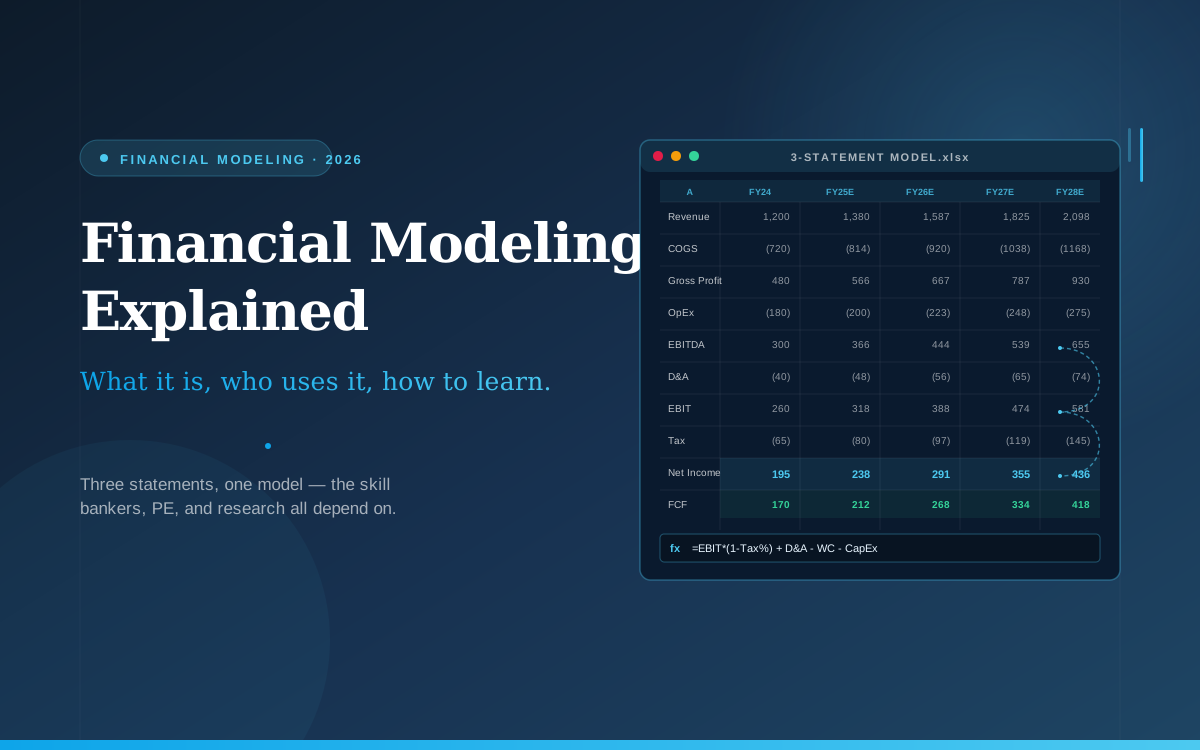
The three-statement model links the income statement, balance sheet, and cash flow statement into a single integrated spreadsheet. It is the foundation of all financial modeling — every other model type builds on top of it. Analysts use it for forecasting revenue, tracking working capital changes, and projecting debt repayment schedules. If you are new to financial modeling, this is where you start.
2. Discounted Cash Flow (DCF) Model
The DCF model calculates the intrinsic value of a company by projecting its future free cash flows and discounting them back to present value using a weighted average cost of capital (WACC). It is the most commonly used intrinsic valuation method in investment banking and equity research. Getting the assumptions right — growth rates, terminal value, discount rate — is where the real skill lies.
3. Comparable Company Analysis (Comps)
Comps is a relative valuation method. You identify a set of publicly traded companies similar to the target (in industry, size, and growth profile), calculate valuation multiples like EV/EBITDA or P/E, and apply them to derive a valuation range. It is fast, market-driven, and widely used in equity research coverage and IPO pricing across Indian markets.
4. Merger & Acquisition (M&A) Model
An M&A model evaluates the financial impact of one company acquiring another. It calculates whether the deal is accretive or dilutive to the acquirer's earnings per share, models synergies, and analyses different financing structures (cash, stock, or a mix). Investment bankers build these models to advise boards on deal terms and negotiate transaction prices.
5. Leveraged Buyout (LBO) Model
The LBO model is the signature model of private equity. It evaluates whether a company can be acquired using significant debt financing, generate enough cash flow to service that debt, and deliver a target return (typically 20%+ IRR) to equity sponsors over a 3–7 year hold period. It involves complex debt scheduling, cash flow waterfalls, and sensitivity analysis on entry and exit multiples.
| Model Type | Primary Use Case | Key Output | Complexity |
|---|---|---|---|
| 3-Statement | Forecasting & Budgeting | Projected Financials | Beginner |
| DCF | Intrinsic Valuation | Enterprise Value | Intermediate |
| Comps | Relative Valuation | Valuation Range | Beginner |
| M&A | Deal Advisory | Accretion/Dilution | Advanced |
| LBO | PE Buyouts | IRR & Money Multiple | Advanced |
Who Uses Financial Modeling?
Financial modeling is not confined to a single role or industry. It is a core skill that spans the entire financial services ecosystem. Here is where financial models are built and used every single day:
Investment Banking
Investment bankers are the heaviest users of financial models. Analysts and associates build DCF, Comps, M&A, and LBO models for pitchbooks, fairness opinions, and live deal execution. At firms like Kotak Investment Banking, Avendus, JM Financial, and bulge-bracket banks such as Goldman Sachs and JP Morgan, financial modeling is the primary daily activity for junior bankers. Every IPO, every M&A advisory mandate, and every debt capital markets deal requires a detailed financial model.
Private Equity
PE firms live and breathe LBO models. Whether it is a mid-market fund like Multiples Alternate Asset Management or a global giant like KKR or Warburg Pincus, the investment team builds detailed LBO models to evaluate potential acquisitions, model different leverage scenarios, and calculate expected returns for limited partners. Portfolio monitoring also requires regular model updates.
Equity Research
Equity research analysts at brokerages like Motilal Oswal, ICICI Securities, and Jefferies build 3-statement models and DCF valuations for every stock they cover. Their models drive buy/sell/hold recommendations and target price estimates. The ability to build accurate, detailed models is what separates a top-ranked analyst from the rest.
Corporate Finance & FP&A
Inside companies, the corporate finance and financial planning & analysis (FP&A) teams use financial models for annual budgeting, variance analysis, capital expenditure planning, and scenario modelling. Whether it is a Reliance Industries planning a new refinery or a D2C startup projecting its burn rate, financial models are the decision-making backbone.
Venture Capital & Startups
Startup founders build financial models for fundraising — projecting unit economics, customer acquisition costs, and runway. VC analysts evaluate these models during due diligence to assess whether the startup's growth assumptions are realistic and whether the valuation being asked for is justified.
Essential Skills & Tools for Financial Modeling
Building a financial model requires a combination of technical proficiency, accounting knowledge, and business judgement. Here are the non-negotiable skills and tools you need:
Core Skills
- Accounting Fundamentals: You must understand how the three financial statements connect — how net income flows to retained earnings, how depreciation links to capex, and how working capital changes affect cash flow. Without this, your model will have circular errors.
- Excel Proficiency: Advanced Excel skills are mandatory. This includes INDEX-MATCH, OFFSET, data tables, conditional formatting, named ranges, and keyboard shortcuts. Speed matters — investment banking analysts who model slowly get replaced.
- Valuation Theory: Understanding WACC, terminal value methodologies (Gordon Growth vs Exit Multiple), comparable selection criteria, and control premiums is critical for building defensible models.
- Business Judgement: Knowing which assumptions are reasonable requires understanding of the industry, competitive dynamics, and macroeconomic environment. A technically perfect model with unrealistic assumptions is worthless.
- Attention to Detail: A single mislinked cell can cascade errors through an entire model. Top modellers develop systematic error-checking habits and always build in balance checks.
Tools of the Trade
| Tool | Usage | Who Uses It | Learning Curve |
|---|---|---|---|
| Microsoft Excel | Primary modeling tool globally | Everyone | Medium |
| Google Sheets | Collaborative models, startups | Startups, VC | Low |
| Python (pandas, NumPy) | Data analysis, automation | Quant funds, FP&A | High |
| Bloomberg Terminal | Market data, comps sourcing | IB, ER, PE | Medium |
| Capital IQ / Refinitiv | Financial data & screening | IB, ER | Medium |
| Power BI / Tableau | Model output visualisation | Corporate Finance | Medium |
Key Takeaway
Excel remains the undisputed king of financial modeling in investment banking and private equity. Python is gaining ground for data processing and automation, but no hiring manager will accept a Python script in place of a well-structured Excel model during an interview. Learn Excel first, then add Python as a complementary skill.
Career Paths in Financial Modeling
Financial modeling opens doors to some of the most competitive and high-paying roles in finance. The career trajectory typically follows a well-defined path, though the exact route depends on whether you enter investment banking, private equity, equity research, or corporate finance.
Investment Banking Track
Analyst (2–3 years) → Associate (3 years) → Vice President (3–4 years) → Director/ED → Managing Director. Analysts build models from scratch, associates review and refine them, and VPs present them to clients. Financial modeling is the core skill at every level through VP.
Private Equity Track
Analyst/Associate (2–3 years) → Senior Associate/VP (3–4 years) → Principal → Partner. PE professionals use financial models for deal screening, due diligence, portfolio monitoring, and exit planning. LBO modeling ability is the single most important technical skill for PE recruitment.
Corporate Finance / FP&A Track
Financial Analyst → Senior Analyst → FP&A Manager → Director of Finance → VP Finance → CFO. In this track, financial modeling is used for budgeting, forecasting, capital allocation, and strategic planning. The work-life balance is significantly better than banking, though compensation is lower at junior levels.
Financial Modeling Salary in India
Compensation for professionals with strong financial modeling skills varies significantly based on the role, firm type, city, and years of experience. Here is what you can realistically expect in the Indian market:
| Role | Experience | Annual CTC (INR) | Top Recruiters |
|---|---|---|---|
| IB Analyst | 0–2 years | 6–15 Lakhs | Kotak IB, Avendus, Axis Capital |
| IB Associate | 2–5 years | 15–35 Lakhs | Goldman Sachs, JP Morgan, Citi |
| PE Associate | 2–5 years | 18–45 Lakhs | KKR, Warburg Pincus, Multiples |
| Equity Research Analyst | 0–3 years | 5–12 Lakhs | Motilal Oswal, ICICI Sec, Jefferies |
| FP&A Analyst | 0–3 years | 4–10 Lakhs | Big 4, Fortune 500 GCCs |
| Corp Finance VP | 8+ years | 30–60+ Lakhs | Reliance, TCS, Tata Group |
Note: Salaries at global banks and top PE firms in Mumbai can be 2–3x higher than domestic firms. Bulge-bracket IB analysts in India can earn upwards of 20 lakhs in their first year when bonuses are included.
How to Learn Financial Modeling
Learning financial modeling requires a structured approach. Watching random YouTube tutorials will not give you the depth needed to pass technical interviews or build models that withstand scrutiny from senior bankers. Here is a proven roadmap:
Step 1: Build Your Accounting Foundation (Weeks 1–2)
Before touching a model, make sure you understand the three financial statements and how they interconnect. Know what drives each line item. If someone asks you how a 10 crore asset purchase affects all three statements, you should be able to walk through the impact without hesitation.
Step 2: Master Excel for Finance (Weeks 2–4)
Learn the Excel functions and shortcuts that financial modellers use daily: INDEX-MATCH, OFFSET, CHOOSE, data validation, conditional formatting, and keyboard-only navigation. Practice formatting models with the blue-for-inputs, black-for-formulas convention. Speed in Excel is a genuine differentiator in banking interviews.
Step 3: Build a 3-Statement Model (Weeks 4–8)
Pick a listed Indian company (Tata Consultancy Services, HDFC Bank, or Asian Paints work well), gather its annual reports, and build a fully integrated 3-statement model from scratch. This is where you develop the muscle memory for linking cells, building schedules (debt, depreciation, working capital), and creating a model that balances.
Step 4: Learn DCF & Comps (Weeks 8–12)
Once your 3-statement model is solid, extend it into a DCF valuation. Learn to calculate WACC, project free cash flows, and compute terminal value using both the Gordon Growth method and the Exit Multiple method. Simultaneously, learn to pull Comps from databases like Capital IQ or build your own Comps tables from annual reports.
Step 5: Advance to M&A & LBO (Weeks 12–20)
These advanced models are what separate good analysts from great ones. Build an M&A merger model with synergies and accretion/dilution analysis. Then tackle an LBO model with multiple debt tranches, a cash sweep mechanism, and returns analysis. Use a real Indian PE deal as your case study for maximum impact in interviews.
Step 6: Practice Under Interview Conditions
The final step is timed practice. Investment banking interviews often include a modeling test where you build a DCF or 3-statement model in 60–90 minutes. Practise building models from a blank spreadsheet with only an annual report — no templates, no notes. This is what separates candidates who get offers from those who do not.
Key Takeaway
The fastest way to learn financial modeling is through a structured programme that combines theory, guided model-building with real company data, and timed interview practice. Self-study is possible but typically takes 2–3x longer and lacks the feedback loop needed to catch modelling errors early.
Best Financial Modeling Courses & Certifications
Choosing the right course can shave months off your learning curve and dramatically improve your placement outcomes. Here is what to look for in a financial modeling programme, along with the leading options in India:
What to Look for in a Financial Modeling Course
- Live case studies: The course should use real Indian and global company data, not hypothetical examples. Building a DCF for Infosys or an LBO for a real PE deal teaches you far more than textbook exercises.
- All model types covered: A comprehensive programme covers 3-Statement, DCF, Comps, M&A, and LBO models at minimum. Avoid courses that only teach one or two model types.
- Excel-first approach: Models should be built from scratch in Excel, not in proprietary software. Interviewers will test you in Excel.
- Placement support: The best programmes offer resume building, mock interviews, and direct connections with hiring managers at banks, PE firms, and corporates.
- Industry-recognised certification: A certification that recruiters recognise adds credibility to your profile, especially for career switchers.
| Programme | Coverage | Format | Best For |
|---|---|---|---|
| QuintEdge Financial Modeling | All 5 core models + advanced | Live online & classroom | IB, PE, ER aspirants |
| FMVA (CFI) | 3-Statement, DCF, Comps | Self-paced online | Global certification |
| WSP (Wall Street Prep) | All model types | Self-paced online | US-focused career prep |
| NSE Academy Certification | Basic modeling | Online | Indian market context |
| CFA Institute (L1-L3) | Valuation theory (not hands-on) | Self-study + exam | Broad finance knowledge |
While global certifications like FMVA and Wall Street Prep have strong brand recognition, they lack India-specific case studies and placement support in the Indian market. For professionals targeting roles at Indian banks, domestic PE funds, or GCC offices, a programme with local deal experience and recruiter networks provides a distinct advantage.
Frequently Asked Questions
Financial modeling is the process of creating a spreadsheet-based representation of a company's financial performance. It uses historical data and assumptions to project future revenues, expenses, and cash flows. Analysts use these models to make decisions about investments, acquisitions, lending, and budgeting. Think of it as a financial simulation that helps answer “what if” questions about a business.
Yes. Financial modeling is one of the highest-demand skills in India's finance sector. The growing IPO pipeline, increasing M&A activity, and expansion of PE/VC funds in India have created strong demand for skilled modellers. Entry-level salaries at investment banks range from 6–15 lakhs, rising quickly to 25–45 lakhs at the associate level. The skill is equally valuable in corporate finance, equity research, and consulting roles.
Absolutely. Many successful financial modellers come from engineering, economics, or even arts backgrounds. You will need to build a foundation in accounting and corporate finance concepts, but a structured course can teach you this alongside the modeling skills. Strong Excel skills and analytical thinking matter more than your undergraduate degree. Engineers often excel at financial modeling due to their comfort with structured problem-solving.
With a structured programme and consistent practice, you can build basic 3-Statement and DCF models in 6–8 weeks. Reaching proficiency across all five core model types (including M&A and LBO) typically takes 4–6 months. Mastery — where you can build any model from scratch under timed interview conditions — usually requires 6–12 months of regular practice. Self-study takes significantly longer than guided learning.
Not in the near term. Excel remains the industry standard for financial modeling in investment banking, private equity, and equity research. Python is increasingly used for data processing, automation of repetitive tasks, and quantitative analysis, but it has not replaced the core Excel-based modeling workflow. The best approach is to master Excel first and then learn Python as a complementary tool for data extraction and analysis.
A DCF model calculates the intrinsic value of a company by discounting its projected free cash flows to present value. It answers the question: “What is this company worth based on its future earnings potential?” An LBO model, on the other hand, evaluates whether a company can be acquired using significant debt, generate enough cash to repay that debt, and deliver a target return (typically 20%+ IRR) to the private equity buyer. DCF is a valuation tool; LBO is a transaction analysis tool.
For professionals targeting roles in the Indian market, a programme that combines global modeling standards with India-specific case studies and local placement networks works best. Global certifications like FMVA (CFI) and Wall Street Prep have strong brand recognition but lack Indian deal context. QuintEdge's Financial Modeling programme bridges this gap with live Indian company models, recruiter connections at top banks, and placement assistance tailored to the Indian job market.
No. The CFA programme covers valuation theory and financial analysis concepts but does not teach hands-on model building in Excel. You can have a successful career in financial modeling without a CFA charter. However, combining practical modeling skills with CFA knowledge creates a very strong profile, particularly for equity research and asset management roles. Many professionals pursue both in parallel.