
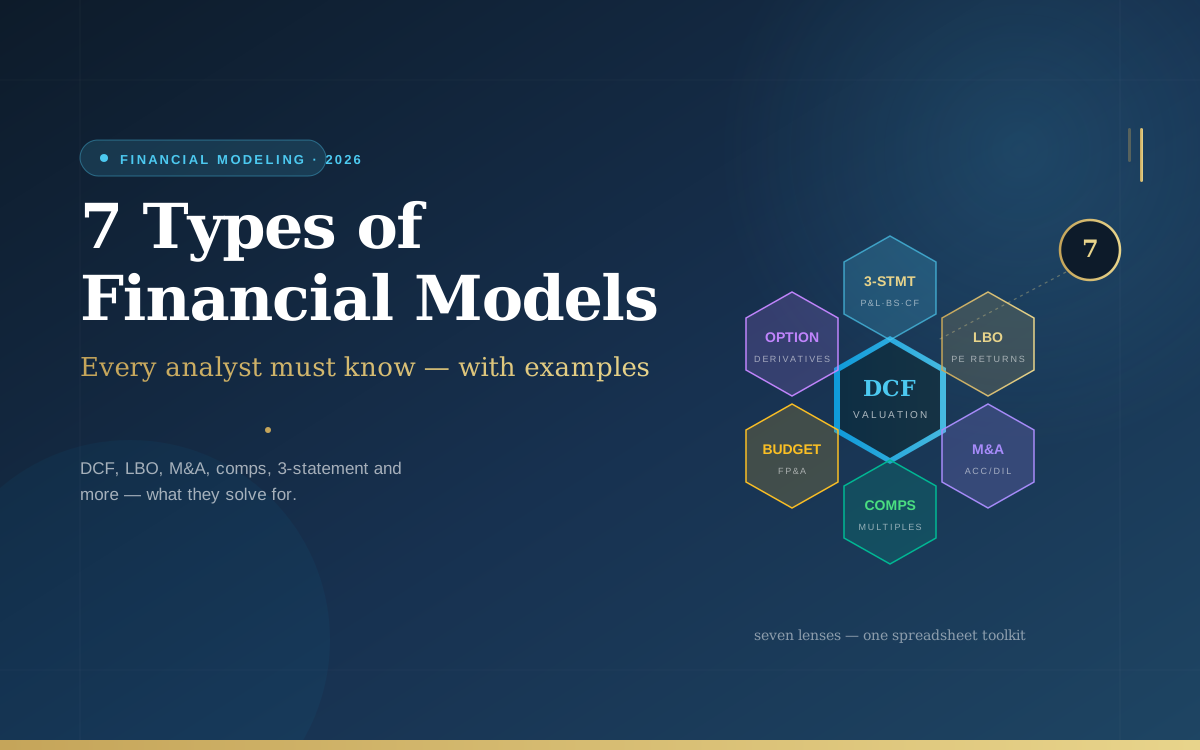
Financial models are the backbone of every major business decision in corporate finance, investment banking, and equity research. Whether an analyst at Kotak Securities is initiating coverage on a stock, a private equity fund is evaluating an acquisition, or a CFO at Reliance Industries is planning a capital expenditure cycle — a financial model sits at the centre of the decision.
But not all financial models are the same. Different situations demand different modelling approaches. A DCF model that works for valuing TCS would be entirely unsuitable for evaluating a leveraged buyout of a mid-market company. An M&A merger model built for analysing the HDFC–HDFC Bank merger serves a fundamentally different purpose than a comparable company analysis used to price an IPO.
This guide walks you through the 7 essential types of financial models that every analyst must understand. For each model, we cover what it is, when it is used, a real-world Indian company example, the key inputs and outputs, and the difficulty level. If you are preparing for an investment banking career or want to deepen your financial modelling skills, this is the definitive reference you need.
Key Takeaway
The Three-Statement Model is the foundation — every other model builds on it. DCF and Comps are the most frequently used valuation tools. LBO and M&A models are advanced but essential for investment banking roles. Master all seven to become a complete analyst.
Why Financial Models Matter for Every Finance Professional
A financial model is a mathematical representation of a company’s financial performance, typically built in Excel or Google Sheets. It translates business assumptions — revenue growth, operating margins, capital expenditure, working capital needs — into projected financial statements and valuation outputs.
Financial models are used across virtually every function in finance:
- Investment banking analysts build models to advise on M&A transactions, IPO pricing, and debt issuances.
- Equity research analysts use models to set target prices and issue buy/sell/hold recommendations.
- Private equity professionals model leveraged buyouts to determine return potential on acquisitions.
- Corporate finance teams at companies like Infosys, Reliance, and HDFC Bank use models for budgeting, forecasting, and strategic planning.
- Credit analysts at banks and rating agencies model debt serviceability and default risk.
The ability to build, audit, and interpret financial models is not optional for finance professionals — it is a core competency. According to industry surveys, financial modelling proficiency is the number-one technical skill sought by investment banks and PE firms during hiring. For a step-by-step learning path, see our guide on how to build a financial model from scratch.
1. Three-Statement Model — The Foundation of All Financial Models
Three-Statement Model
What It Is
The Three-Statement Model links a company’s Income Statement, Balance Sheet, and Cash Flow Statement into a single, dynamic, integrated model. Changes in revenue assumptions automatically flow through operating expenses, tax, net income, working capital, capital expenditure, debt, and cash balances. It is the foundational model upon which every other financial model is built.
When It Is Used
Every financial analysis starts here. Equity research analysts use it for earnings forecasts. Credit analysts use it to assess repayment capacity. Corporate FP&A teams use it for annual budgeting. It is also the starting point before building a DCF, LBO, or M&A model.
Real-World Example
An analyst at ICICI Securities initiating coverage on TCS (Tata Consultancy Services) would first build a Three-Statement Model projecting TCS’s revenue (by geography and vertical), EBIT margins, depreciation, tax rate, working capital cycle (debtor days, payable days), and capex over a 5-year forecast period. This model becomes the foundation for a DCF valuation or peer comparison.
Key Inputs & Outputs
- Inputs: Revenue growth assumptions, operating margin, tax rate, capex, depreciation schedule, working capital assumptions, debt schedule.
- Outputs: Projected income statement, balance sheet, cash flow statement, key ratios (ROE, ROCE, debt/equity).
2. DCF (Discounted Cash Flow) Model — Intrinsic Valuation
Discounted Cash Flow (DCF) Model
What It Is
The DCF model calculates a company’s intrinsic value by projecting its future free cash flows (FCF) and discounting them back to present value using the weighted average cost of capital (WACC). It answers the fundamental question: what is this business worth today based on the cash it will generate in the future?
When It Is Used
DCF is the primary intrinsic valuation method used in equity research, investment banking pitch books, private equity due diligence, and corporate M&A analysis. It is especially useful for companies with predictable, stable cash flows — think large-cap IT services, FMCG, and pharma companies in India.
Real-World Example
A portfolio manager at HDFC AMC valuing Infosys would build a DCF model projecting Infosys’s free cash flows over 10 years based on revenue growth (constant currency terms), EBIT margin trajectory, tax rate (considering SEZ benefits), capex intensity, and working capital. The terminal value (using a perpetuity growth method at ~4%) would typically represent 60–70% of total enterprise value. Using a WACC of approximately 11–12%, the model produces an intrinsic value per share that the manager compares against the current market price.
Key Inputs & Outputs
- Inputs: Revenue projections, FCF forecasts, WACC (cost of equity via CAPM + cost of debt), terminal growth rate, projection period.
- Outputs: Enterprise value, equity value, implied share price, sensitivity tables (WACC vs terminal growth).
3. Comparable Company Analysis (Comps) — Relative Valuation
Comparable Company Analysis (Comps)
What It Is
Comps (also called trading multiples analysis) values a company by comparing its financial metrics and valuation multiples — such as EV/EBITDA, P/E, EV/Revenue, and P/B — against a set of similar publicly traded companies. The logic is straightforward: similar companies should trade at similar multiples.
When It Is Used
Comps are used in virtually every equity research report, IPO pricing exercise, fairness opinion, and quick valuation check. It is the fastest valuation method and provides a market-based perspective that complements the DCF’s intrinsic approach. Investment banks use Comps extensively in pitch books alongside DCF to present a valuation range.
Real-World Example
An analyst valuing Bajaj Finance would select a peer set of comparable NBFCs — Shriram Finance, Mahindra & Mahindra Financial Services, Cholamandalam Investment, and L&T Finance — and compare metrics like P/B ratio, P/E ratio, ROE, and NIM. If the peer median P/B is 3.5x and Bajaj Finance trades at 7.2x, the analyst must justify the premium through superior asset quality, growth rate, and return on equity.
Key Inputs & Outputs
- Inputs: Peer group selection, financial metrics (revenue, EBITDA, net income, book value), current market data (market cap, enterprise value).
- Outputs: Trading multiples (EV/EBITDA, P/E, P/B, EV/Revenue), implied valuation range, median/mean multiples, valuation premium or discount.
4. Precedent Transaction Analysis — M&A-Based Valuation
Precedent Transaction Analysis
What It Is
Precedent Transaction Analysis (also called deal comps or transaction multiples) values a company by examining the multiples paid in past M&A transactions involving similar companies. Unlike trading Comps (which use current market prices), precedent transactions reflect the actual prices acquirers were willing to pay — which typically include a control premium of 20–40% over market value.
When It Is Used
This method is primarily used in M&A advisory, fairness opinions, and situations where an analyst needs to determine what a company is worth in an acquisition context. It is the go-to approach when advising a board of directors on whether a takeover offer is fair.
Real-World Example
When advising on an acquisition in the Indian cement sector, an investment banker would examine precedent transactions such as the Adani Group’s acquisition of ACC and Ambuja Cements from Holcim, UltraTech’s past acquisitions (Jaypee, Century Textiles’ cement division), and Dalmia Bharat’s acquisitions. Analysing the EV/tonne and EV/EBITDA multiples paid in these transactions establishes a benchmark for the current deal.
Key Inputs & Outputs
- Inputs: Comparable past transactions (deal value, target financials at time of deal), transaction multiples, date of transaction, deal context (hostile vs friendly, strategic vs financial buyer).
- Outputs: Transaction multiples (EV/EBITDA, EV/Revenue, EV/tonne for specific industries), implied valuation range, control premium analysis.
5. LBO (Leveraged Buyout) Model — The PE Analyst’s Workhorse
Leveraged Buyout (LBO) Model
What It Is
The LBO model simulates the acquisition of a company using a significant amount of debt (leverage) combined with a smaller equity contribution from the buyer (typically a private equity fund). The model tracks how the acquired company’s cash flows are used to service and repay debt over a 5–7 year hold period, and calculates the internal rate of return (IRR) and multiple of money (MOIC) for the equity investors at exit.
When It Is Used
LBO models are the standard analytical tool for private equity firms evaluating potential acquisitions. They are also used by investment banks advising on leveraged transactions, and increasingly in investment banking interviews at associate and VP levels. In India, as the PE market matures with firms like KKR, Blackstone, Warburg Pincus, and ChrysCapital deploying large amounts of capital, LBO modelling skills are in growing demand.
Real-World Example
When Blackstone evaluated and executed its acquisition of a controlling stake in Mphasis, the PE team would have built a detailed LBO model. Key inputs: acquisition enterprise value (~₹17,000 crore), debt-to-equity structure (perhaps 40% debt / 60% equity), Mphasis’s projected EBITDA growth over 5 years, debt repayment schedule from free cash flows, and an assumed exit multiple (EV/EBITDA). The output: an expected IRR of 20–25%+ for Blackstone’s fund.
Key Inputs & Outputs
- Inputs: Purchase price, debt structure (senior, mezzanine, equity split), interest rates, repayment schedule, projected EBITDA and FCF, exit multiple, hold period.
- Outputs: IRR (Internal Rate of Return), MOIC (Multiple of Invested Capital), debt paydown schedule, exit equity value, sensitivity tables (entry multiple vs exit multiple vs leverage).
6. M&A (Merger) Model — Accretion/Dilution Analysis
M&A Merger Model
What It Is
The M&A Merger Model (also called an accretion/dilution model) analyses the financial impact of one company acquiring another. It combines the financial statements of the acquirer and target, incorporates the deal structure (cash, stock, or a mix), models synergies (cost savings and revenue enhancements), and determines whether the transaction is accretive (increases the acquirer’s EPS) or dilutive (decreases EPS) to the acquirer’s shareholders.
When It Is Used
This model is built by investment banking teams advising on M&A transactions. It is critical for the acquirer’s board to understand whether the deal creates or destroys shareholder value. Every major M&A transaction requires accretion/dilution analysis before the board approves the deal.
Real-World Example
The landmark HDFC–HDFC Bank merger (effective July 2023) was one of the largest M&A transactions in Indian corporate history. Investment bankers advising on the deal would have built a detailed merger model combining HDFC Ltd’s mortgage lending book with HDFC Bank’s balance sheet. The model would project the combined entity’s net interest income, cost synergies from eliminating redundant branches and functions, the share exchange ratio (42 HDFC Bank shares for 25 HDFC Ltd shares), and the accretion/dilution impact on HDFC Bank’s EPS over a 3–5 year horizon.
Key Inputs & Outputs
- Inputs: Both companies’ financial statements, deal structure (cash/stock/mix), exchange ratio, synergy assumptions (cost + revenue), transaction fees, financing costs, goodwill and intangible assets.
- Outputs: Pro-forma combined financials, EPS accretion/dilution analysis, combined credit profile, synergy realisation timeline, contribution analysis.
7. Sum-of-the-Parts (SOTP) Model — Valuing Conglomerates
Sum-of-the-Parts (SOTP) Model
What It Is
The SOTP model values a diversified company or conglomerate by separately valuing each of its business segments or subsidiaries using the most appropriate valuation method for that segment (DCF, Comps, or asset-based), and then summing the individual values. It accounts for the fact that different businesses within a conglomerate may have vastly different growth profiles, risk characteristics, and appropriate valuation multiples.
When It Is Used
SOTP is essential when analysing large conglomerates, holding companies, and diversified businesses where a single multiple cannot capture the value of the entire enterprise. It is the standard methodology for analysing companies like Reliance Industries, ITC, Tata Group companies, and Mahindra & Mahindra in India. It is also used to identify a “conglomerate discount” — the difference between the SOTP value and the market cap.
Real-World Example
Valuing Reliance Industries Limited (RIL) is the classic SOTP use case in India. An analyst would value each segment separately: the oil-to-chemicals (O2C) business using EV/EBITDA at refining and petchem peer multiples; Jio Platforms using a DCF or EV/subscriber model benchmarked against global telecom peers; Reliance Retail using EV/Revenue and EV/EBITDA relative to Avenue Supermarts (DMart) and Trent; the media business (Network18/Viacom18) using content and streaming industry multiples; and the new energy ventures using venture-stage methodologies. The total SOTP value is then compared against RIL’s market cap to identify whether the stock is undervalued or overvalued.
Key Inputs & Outputs
- Inputs: Segment-level financials, appropriate valuation methodology per segment, segment-specific peer multiples or DCF assumptions, net debt at the consolidated level, holding company discount (if applicable).
- Outputs: Segment-wise enterprise value, total SOTP enterprise value, equity value after net debt adjustment, implied per-share value, conglomerate discount/premium analysis.
All 7 Financial Models: Quick Comparison
The table below summarises the key characteristics of each model to help you understand when to use which approach.
| Model | Primary Use | Difficulty | Frequency | Key Output |
|---|---|---|---|---|
| Three-Statement | Foundation / Forecasting | Beginner | Every analysis | Projected financials |
| DCF | Intrinsic valuation | Intermediate | Very high | Enterprise value / share price |
| Comps | Relative valuation | Beginner–Intermediate | Very high | Implied valuation range |
| Precedent Transactions | M&A valuation | Intermediate | Moderate | Transaction-based valuation |
| LBO | PE acquisition analysis | Advanced | PE / Advanced IB | IRR, MOIC, debt schedule |
| M&A Merger | Deal impact analysis | Advanced | IB deal teams | Accretion/dilution, pro-forma |
| SOTP | Conglomerate valuation | Intermediate–Advanced | Conglomerates | Segment-wise + total value |
Model Complexity vs Frequency of Use
The chart below plots each financial model on two axes: how complex it is to build (vertical axis) and how frequently it is used across the finance industry (horizontal axis). Models in the top-left are complex but niche; models in the bottom-right are simpler but used constantly.
Financial Model Complexity vs Frequency of Use
Key Takeaway
Start with the Three-Statement Model and Comps — they are the most frequently used and the most accessible. Progress to DCF and Precedent Transactions for valuation depth. LBO and M&A models are advanced but essential for investment banking and private equity careers. SOTP is a must for covering Indian conglomerates like Reliance, ITC, and Mahindra.
How to Learn Financial Modelling: A Practical Roadmap
Mastering all seven types of financial models is a journey, not a sprint. Here is a realistic learning progression that works for Indian finance professionals and students:
- Weeks 1–4: Three-Statement Model. Start by building an integrated model for a well-known Indian company (TCS, HDFC Bank, or Asian Paints). Focus on linking the three statements correctly. Get comfortable with circular references, balancing the balance sheet, and building a dynamic debt schedule.
- Weeks 5–8: DCF and Comps. Extend your Three-Statement Model into a full DCF. Simultaneously, build a Comps analysis for the same sector. Understand when DCF and Comps give different answers and why. Practice sensitivity analysis.
- Weeks 9–12: Precedent Transactions and SOTP. Research actual M&A deals in India (cement, pharma, or NBFC sectors) and build a precedent transaction analysis. Then build a SOTP model for Reliance Industries or ITC.
- Months 4–6: LBO and M&A Models. These are the most complex. Start with a simplified LBO, then add complexity (multiple debt tranches, PIK interest, management rollover). Build a merger model for a real Indian transaction.
For a structured learning experience with mentorship, live projects, and placement support, explore our Financial Modeling certification programme that covers all seven model types with Indian company case studies.
Frequently Asked Questions
The seven most common types are the Three-Statement Model, Discounted Cash Flow (DCF) Model, Comparable Company Analysis (Comps), Precedent Transaction Analysis, Leveraged Buyout (LBO) Model, Merger (M&A) Model, and Sum-of-the-Parts (SOTP) Model. The Three-Statement Model is the foundation, and all other models build on top of it.
The LBO (Leveraged Buyout) model is generally considered the most complex because it requires detailed debt scheduling across multiple tranches, cash flow waterfalls, returns analysis, and sensitivity tables. M&A merger models are a close second due to the complexity of modelling synergies and accretion/dilution analysis.
There is no single best model. Analysts typically use a combination of DCF (for intrinsic value), Comparable Company Analysis (for relative valuation using market multiples), and Precedent Transactions (for M&A-based valuation). Using multiple models provides a valuation range that is more reliable than any single method.
For entry-level analyst roles, you need strong proficiency in the Three-Statement Model, DCF, and Comps. Familiarity with Precedent Transactions is also expected. LBO and M&A models are tested at associate-level interviews and above. Knowing all seven gives you a significant competitive advantage at top banks.
With structured training, you can learn the Three-Statement Model and DCF in 4–6 weeks. Adding Comps, Precedent Transactions, and basic LBO takes another 4–6 weeks. Mastering all seven models typically requires 3–6 months of dedicated practice. A comprehensive financial modelling course accelerates this timeline significantly.
DCF is an intrinsic valuation method that values a company based on projected future cash flows discounted to present value. Comps is a relative valuation method that values a company by comparing its multiples to similar publicly traded companies. DCF tells you what a company should be worth; Comps tells you what the market is currently paying for similar companies.
The Three-Statement Model and Comparable Company Analysis (Comps) are the most frequently used in India. Every equity research report and investment memo starts with a Three-Statement Model. Comps are widely used by analysts at firms like Kotak Securities, ICICI Securities, and Motilal Oswal. DCF models are the third most common, used heavily in investment banking and private equity.