
Types of Investment Banks: Understanding the Landscape
Not all investment banks are created equal. The firm you join shapes everything — the deals you work on, the salary you earn, the hours you put in, and the exit opportunities you unlock. Whether you are a commerce graduate in Mumbai or an MBA candidate at ISB, understanding the different types of investment banks is the first step toward making a strategic career decision.
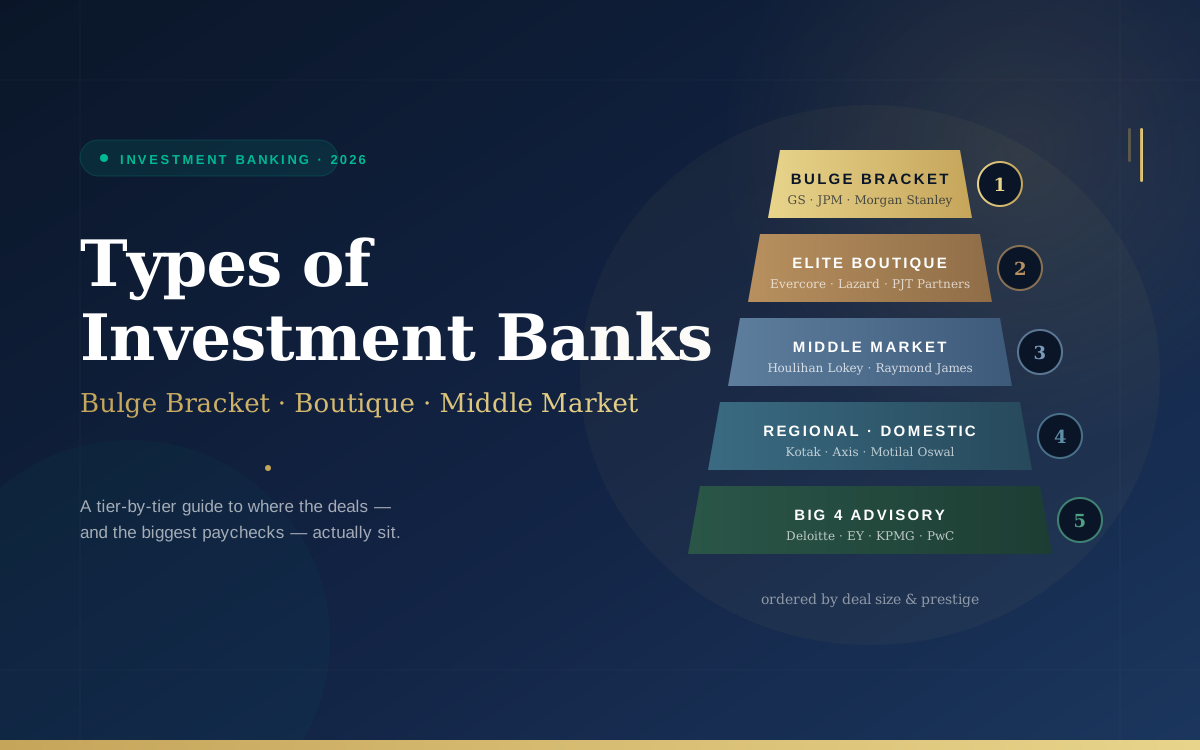
Investment banks are broadly categorized by their size, global reach, deal flow, and advisory focus. The five main categories are Bulge Bracket banks, Elite Boutiques, Middle Market banks, Regional/Domestic banks, and Big 4 Advisory practices. Each type offers a fundamentally different experience, compensation structure, and career trajectory.
This guide breaks down each category with specific firms, salary benchmarks, hiring patterns, and a decision framework to help you choose the right path for your career goals.
1. Bulge Bracket Banks: The Global Powerhouses
Bulge Bracket (BB) banks are the largest, most prestigious investment banks in the world. These firms operate across every continent, handle the biggest deals, and employ thousands of bankers globally. The term originally referred to banks whose names appeared in the largest font on tombstone advertisements for securities offerings.
Key Bulge Bracket firms: Goldman Sachs, JP Morgan, Morgan Stanley, Bank of America (BofA Securities), Citigroup, Barclays, Deutsche Bank, and UBS.
What Defines a Bulge Bracket Bank?
BB banks are full-service institutions. They offer investment banking advisory (M&A, restructuring), capital markets (equity and debt underwriting), sales & trading, asset management, wealth management, and research — all under one roof. Their deal sizes typically start at $1 billion and can stretch beyond $50 billion for mega-mergers.
In India, BB banks like Goldman Sachs, JP Morgan, and Morgan Stanley have significant operations in Mumbai and Bengaluru. They handle cross-border M&A, large IPOs (like the Hyundai India IPO advised by multiple BB banks), and marquee capital markets transactions.
Salary & Compensation
At the analyst level in India, BB banks typically offer base salaries of INR 15-25 lakh per annum, with total compensation (including bonuses) reaching INR 25-45 lakh. In New York or London, first-year analysts earn $110,000-$120,000 base with all-in compensation of $170,000-$200,000. Bonuses at BB banks are heavily tied to firm-wide revenue performance.
Culture & Hours
Expect 80-100 hour weeks during live deals. BB banks have a hierarchical culture with large deal teams. As an analyst, you may be one of four or five analysts on a single deal, which means less direct exposure to senior bankers and clients. The trade-off is unmatched brand recognition and exit opportunities into private equity, hedge funds, and corporate strategy.
Hiring Patterns in India
BB banks in India recruit heavily from IIMs (Ahmedabad, Bangalore, Calcutta), ISB, SRCC, St. Xavier's Kolkata, and select engineering colleges (IITs). Lateral hiring is competitive and usually requires prior experience at another BB, Big 4, or top domestic bank.
2. Elite Boutique Banks: Advisory Excellence
Elite Boutiques (EBs) are smaller firms that focus almost exclusively on advisory services — primarily M&A, restructuring, and strategic advisory. They do not have sales & trading desks or large capital markets operations. What they lack in size, they make up for in prestige, deal quality, and per-banker economics.
Key Elite Boutique firms: Evercore, Lazard, Centerview Partners, PJT Partners, Moelis & Company, and Rothschild & Co.
Why Elite Boutiques Stand Out
EBs are hired specifically for their independent, conflict-free advice. Since they do not underwrite securities or lend money, they have no competing interests when advising on a transaction. This independence makes them the advisor of choice for boards of directors during hostile takeovers, activist defense situations, and complex restructurings.
Deal teams at EBs are lean — often just two to three people. This means analysts get significantly more responsibility, direct partner access, and client-facing exposure from day one. At Evercore or Centerview, a first-year analyst might be building the entire model and sitting in the room during board presentations.
Compensation vs Bulge Bracket
Elite Boutiques consistently match or exceed BB compensation. Evercore and Centerview are known for paying top-of-street bonuses. First-year analysts at top EBs in New York can earn $200,000-$230,000 all-in. The per-banker revenue at firms like Centerview is among the highest in the industry, which translates directly into compensation.
In India, EB presence is more limited. Lazard and Rothschild have Indian operations, but firms like Evercore and Centerview do not have dedicated India offices. Indian professionals typically access EB roles through MBA programs abroad or lateral moves from BB banks.
Career Path & Exit Opportunities
EB analysts are heavily recruited by top-tier private equity firms (KKR, Blackstone, Warburg Pincus, Apollo). The lean team structure means EB analysts develop stronger standalone modeling and analytical skills, which PE firms value highly. Restructuring-focused bankers from Lazard, PJT, or Evercore also have strong paths into distressed debt funds and special situations investing.
3. Middle Market Banks: The Sweet Spot?
Middle Market (MM) banks serve companies with enterprise values typically between $100 million and $1 billion. These firms handle a high volume of deals, offer more sector specialization, and are often considered the best balance between deal exposure, compensation, and work-life quality.
Key Middle Market firms: Houlihan Lokey, William Blair, Jefferies, Piper Sandler, Raymond James, and Baird.
The Middle Market Advantage
MM banks are where you get the most reps. Because deal sizes are smaller, deal cycles are shorter, and teams are lean, an analyst at Houlihan Lokey or William Blair might work on 8-12 deals per year compared to 2-3 at a BB. This volume accelerates skill development dramatically.
Many MM banks have built dominant franchises in specific sectors. Houlihan Lokey is the undisputed leader in restructuring and financial opinions (fairness opinions). William Blair dominates in technology and healthcare M&A. Piper Sandler is a powerhouse in healthcare banking. These sector specializations create deep expertise that clients pay a premium for.
Work-Life Balance & Culture
While investment banking is never a 9-to-5 job, MM banks generally offer more predictable hours — typically 65-80 hours per week. The culture tends to be more collaborative and less hierarchical. Analysts interact directly with Managing Directors and clients more frequently than their BB counterparts.
Compensation at Middle Market Banks
MM compensation is competitive but typically 10-25% below BB levels at the analyst and associate ranks. First-year analysts in the US earn $90,000-$110,000 base with all-in compensation of $130,000-$170,000. However, firms like Jefferies and Houlihan Lokey have been closing the gap, especially for top performers.
Key Takeaway
Middle Market banks offer the highest deal volume per banker, making them ideal for candidates who want to develop technical skills rapidly. If your goal is to learn financial modeling, due diligence, and deal execution thoroughly, MM banks give you more at-bats than any other category.
4. Regional & Domestic Banks in India
For professionals building careers in India, domestic investment banks represent the most accessible entry point and often the most relevant deal experience. These firms focus on India-centric transactions — domestic M&A, IPOs on the BSE/NSE, rights issues, qualified institutional placements (QIPs), and block deals.
Key Indian domestic banks: Kotak Investment Banking, Axis Capital, IIFL Securities, JM Financial, SBI Capital Markets (SBI Caps), Avendus Capital, Motilal Oswal Investment Banking, and Ambit Capital.
The Indian IB Landscape
Indian domestic banks dominate the mid-market deal flow in the country. Kotak Investment Banking consistently ranks among the top advisors for Indian IPOs and has handled landmark transactions across sectors. Avendus Capital has carved a niche in technology and digital economy deals, advising on major transactions in the startup and growth-stage ecosystem. JM Financial has a strong heritage in debt capital markets and restructuring.
SBI Caps, as the investment banking arm of the State Bank of India, handles a significant volume of government-related transactions, PSU disinvestments, and large infrastructure financing deals.
Salary at Indian Domestic Banks
Analyst-level salaries at top domestic banks range from INR 8-18 lakh per annum, with total compensation (including bonuses and deal-linked incentives) reaching INR 12-25 lakh. Senior roles (VP and above) can command INR 40-80 lakh, with top performers at firms like Kotak and Avendus earning over INR 1 crore at the Director/MD level.
Hiring Patterns
Domestic banks have a broader hiring funnel compared to BB banks. While top-tier MBA programs (IIMs, XLRI, FMS Delhi, MDI Gurgaon) remain key feeders, these firms also hire from strong undergraduate programs (SRCC, Hindu College, Symbiosis), CA firms, and through lateral recruitment. Many domestic banks actively recruit Chartered Accountants, making the CA qualification a genuine entry point into Indian investment banking.
Career Trajectory
The career path at Indian domestic banks can lead to senior IB roles, transitions to PE/VC firms operating in India (Kedaara, ChrysCapital, Multiples, India Quotient), corporate development roles at Indian conglomerates, or CFO-track positions at mid-size companies. Professionals who build strong sector expertise at domestic banks are highly valued across the Indian financial ecosystem.
5. Big 4 Advisory Practices
The Big 4 accounting firms — Deloitte, EY (Ernst & Young), PwC, and KPMG — have built substantial transaction advisory and corporate finance practices that compete with traditional investment banks on many deal types.
How Big 4 Advisory Differs from Pure IB
Big 4 transaction advisory teams typically focus on due diligence (financial, tax, commercial), valuation advisory, transaction support, and increasingly M&A advisory. Unlike BB or EB banks, Big 4 firms do not underwrite securities. Their advisory work is often on the buy-side — helping PE firms and corporates evaluate acquisition targets — rather than sell-side mandates.
In India, Big 4 deal advisory teams are very active. Deloitte's M&A advisory, EY's Transaction Advisory Services (TAS), PwC's Deals practice, and KPMG's Deal Advisory handle a significant volume of mid-market transactions, PE deal support, and cross-border advisory. Many PE firms in India retain Big 4 teams for financial due diligence on almost every deal.
Compensation & Career Path
Big 4 transaction advisory salaries in India start at INR 7-14 lakh for analysts/associates, reaching INR 20-35 lakh at the manager level. The compensation is generally lower than pure IB roles at BB or top domestic banks, but the hours are more manageable (55-70 hours per week) and the work-life balance is notably better.
The career path leads to senior advisory roles within the Big 4, transitions to corporate development or corporate finance functions, PE fund operations roles, or lateral moves into pure IB. Many professionals use Big 4 TAS as a stepping stone — gaining deal exposure and technical skills before moving to a bank or PE firm.
Advantages of Big 4 Advisory
The Big 4 offer a wider hiring funnel, structured training programs, international mobility (secondments to other offices), and exposure to a large variety of deal types. For professionals who value learning breadth over deal-size prestige, Big 4 advisory is an excellent starting point.
6. Comprehensive Comparison: All Five Bank Types
The table below compares the five investment bank categories across the metrics that matter most for career decisions.
| Parameter | Bulge Bracket | Elite Boutique | Middle Market | Domestic (India) | Big 4 Advisory |
|---|---|---|---|---|---|
| Top Firms | Goldman Sachs, JP Morgan, Morgan Stanley | Evercore, Lazard, Centerview, PJT | Houlihan Lokey, Jefferies, William Blair | Kotak IB, Axis Capital, Avendus, JM Financial | Deloitte, EY, PwC, KPMG |
| Typical Deal Size | $1B - $50B+ | $500M - $20B+ | $100M - $1B | $10M - $500M | $50M - $2B |
| Analyst Salary (India) | INR 25-45L total | INR 20-40L total | INR 15-30L total | INR 12-25L total | INR 7-20L total |
| Weekly Hours | 80-100 | 80-100 | 65-80 | 60-75 | 55-70 |
| Deal Volume/Year | 2-4 deals | 3-5 deals | 8-12 deals | 6-10 deals | 10-15 engagements |
| Client Exposure | Limited at junior level | High — lean teams | Moderate to high | High | Moderate |
| Culture | Hierarchical, prestige-driven | Meritocratic, intense | Collaborative, specialized | Relationship-driven | Structured, process-oriented |
| Top Exit Opportunities | Mega-fund PE, hedge funds, top MBA | Top PE, HFs, corporate boards | MM PE, growth equity, corp dev | India PE/VC, corp finance, CFO track | Corp dev, PE ops, IB lateral |
| Brand Recognition | Highest globally | Highest within finance | Strong in sector | Strong in India | Strong across industries |
| Hiring Difficulty | Very high — target schools only | Extremely high | High but broader funnel | Moderate | Moderate |
Key Takeaway
There is no universally "best" type of investment bank. Bulge Brackets offer brand prestige and mega-deal exposure. Elite Boutiques offer the best advisory experience and compensation. Middle Market banks offer the most learning per hour worked. Domestic banks offer accessibility and India-relevant deal flow. Big 4 firms offer the widest entry funnel and structured career progression. Your choice should align with your specific career goals, not general prestige rankings.
7. Which Type of Investment Bank Is Right for You?
Choosing the right type of bank requires honest self-assessment across four dimensions: your career goal, your current profile strength, your risk tolerance, and your work-life preferences.
Decision Framework
Choose Bulge Bracket if: You are from a target school (IIM-A/B/C, ISB, top IIT), you want the strongest possible brand on your resume, your goal is to exit into mega-fund PE (KKR, Blackstone, Bain Capital) or a top MBA program (Wharton, HBS), and you are willing to sacrifice work-life balance for 2-3 years.
Choose Elite Boutique if: You prioritize advisory skill development over brand breadth, you want maximum responsibility from day one, you are targeting top PE exits, and you can access these roles (often requires an MBA from a top US/UK program or lateral from a BB). If you are based in India, Lazard and Rothschild are the most accessible EB options.
Choose Middle Market if: You want to become technically excellent quickly, you value sector specialization (healthcare, tech, industrials), you want a more sustainable lifestyle while still doing meaningful deals, and you are comfortable with MM PE or growth equity exits rather than mega-fund placements.
Choose Domestic/Regional Banks if: You plan to build your career in India, you are a Chartered Accountant or from a non-target MBA program, you want hands-on deal experience across Indian market transactions, and you are targeting Indian PE/VC firms, corporate finance leadership, or entrepreneurship in financial services.
Choose Big 4 Advisory if: You want a structured entry into deal-oriented work, you value work-life balance more than deal-size prestige, you are early in your career and want exposure to multiple deal types before specializing, or you plan to use transaction advisory as a stepping stone to IB or PE.
The Lateral Move Strategy
Many successful investment bankers in India use a deliberate stepping-stone approach. A common path is: Big 4 TAS or domestic bank (1-2 years) followed by lateral move to BB or top domestic IB (2-3 years) followed by exit to PE/VC or senior corporate role. This strategy works because each move builds incrementally on technical skills, deal experience, and professional network.
Final Thoughts
The investment banking landscape is not a single monolith — it is a diverse ecosystem of firms serving different market segments, offering different experiences, and leading to different career outcomes. Understanding these distinctions early gives you a strategic advantage in targeting the right firms, preparing for the right interviews, and building the right skill set.
For Indian professionals, the domestic banking ecosystem offers genuine opportunities that do not require an IIM pedigree or a US MBA. At the same time, global banks and elite boutiques remain accessible for those with the right preparation, credentials, and persistence. The key is to match your bank type to your career goals — not to chase prestige for its own sake.
Frequently Asked Questions
Bulge Bracket banks (Goldman Sachs, JP Morgan, Morgan Stanley) are full-service institutions offering advisory, capital markets, trading, and asset management. Elite Boutiques (Evercore, Lazard, Centerview) focus almost exclusively on advisory services — primarily M&A and restructuring. EBs offer leaner teams, more responsibility per banker, and often match or exceed BB compensation. BBs offer broader brand recognition and a wider range of exit opportunities.
Bulge Bracket banks pay the highest at the analyst level in India, with total compensation of INR 25-45 lakh per annum. Elite Boutiques with India presence (Lazard, Rothschild) offer INR 20-40 lakh. Top domestic banks like Kotak IB and Avendus offer INR 12-25 lakh at the analyst level. However, at senior levels (VP and above), compensation across categories converges, especially for top performers at domestic banks.
Yes, lateral moves from domestic banks (Kotak IB, Axis Capital, Avendus) to BB banks (Goldman Sachs, JP Morgan) in India are possible, though competitive. You typically need 1-3 years of strong deal experience, solid technical skills (financial modeling, valuation), and ideally a professional qualification like CA or CFA. Many professionals also use a top MBA program (IIM-A/B/C or ISB) as a bridge to BB recruitment.
Big 4 transaction advisory (Deloitte, EY, PwC, KPMG) is deal-oriented but technically distinct from pure investment banking. Big 4 teams primarily handle due diligence, valuation, and transaction support rather than M&A advisory mandates or securities underwriting. However, the Big 4 have been expanding into M&A advisory, and the experience is increasingly recognized as relevant for lateral moves into IB or PE.
Big 4 advisory practices offer the best work-life balance (55-70 hours/week), followed by domestic/regional banks (60-75 hours) and middle market banks (65-80 hours). Bulge Bracket and Elite Boutique banks demand the most hours (80-100 hours/week), especially during live deals. Keep in mind that work-life balance varies significantly by team, deal cycle, and specific firm culture.
Chartered Accountants have strong hiring prospects at domestic banks (Kotak IB, JM Financial, Avendus, IIFL, Axis Capital), Big 4 transaction advisory (Deloitte TAS, EY TAS, PwC Deals, KPMG Deal Advisory), and increasingly at BB banks for specific roles. The CA qualification is particularly valued at Indian domestic banks and Big 4 firms, where financial due diligence and valuation expertise align directly with the CA skill set.
Yes, Middle Market banks provide excellent exit opportunities into mid-market PE and growth equity firms. Houlihan Lokey, in particular, is a top feeder into restructuring-focused PE funds and special situations investing. While MM banks may not place as many analysts into mega-fund PE (Blackstone, KKR) as BB banks do, they provide strong pathways into firms like Audax, Summit Partners, Genstar, and in India, into firms like Kedaara Capital, ChrysCapital, and Multiples Alternate Asset Management.
Financial modeling is essential across all types of investment banks. BB and EB banks test modeling skills extensively during interviews (DCF, LBO, merger models, comparable company analysis). Domestic banks and Big 4 advisory firms also expect strong modeling proficiency. Building these skills before applying — through courses, certifications, or self-study — significantly improves your chances of landing an IB role, regardless of which bank type you target.