
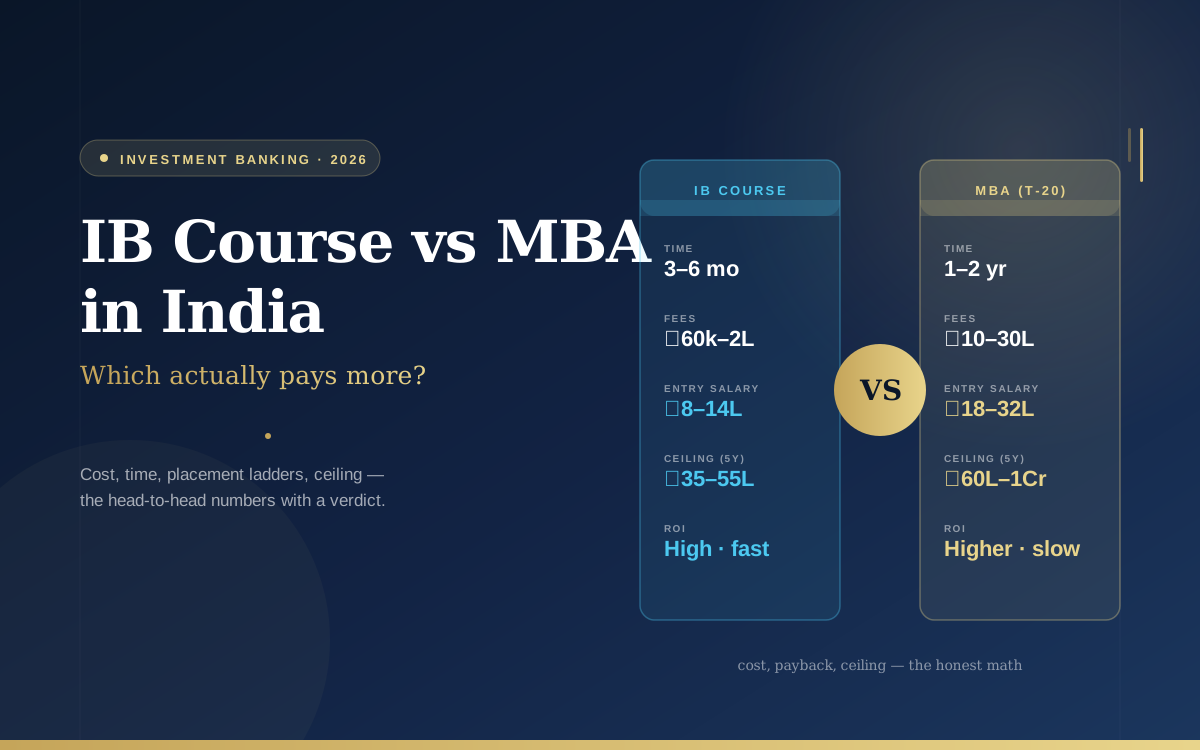
Quick Verdict: IB Course vs MBA
Let us save you 15 minutes of reading if you are in a rush. For most people targeting investment banking careers in India, a dedicated IB course delivers dramatically better ROI than an MBA. The numbers are not even close.
A 3–6 month investment banking course costing ₹1–3 lakh can land you a ₹8–18 LPA role at boutique banks, Big 4 advisory, or GCC finance teams. An MBA costs ₹15–25 lakh in tuition alone — plus two years of lost salary. The math is brutal.
The exception? If you can crack IIM-A, IIM-B, IIM-C, ISB, XLRI, or FMS — the top 10 MBA programmes in India — then the MBA brand and placement pipeline justify the cost. Those schools place directly into bulge bracket banks and mega PE funds. Everywhere else, the MBA advantage for IB specifically is overstated.
Key Takeaway
IB course wins on ROI for 80% of candidates. MBA wins only if you are at a top-10 B-school with a proven IB placement track record. For everyone else, the IB course + certification combo is the smarter financial decision.
What Each Path Actually Involves
Investment Banking Course: Execution-First Training
A quality investment banking course is a 3–6 month intensive programme that teaches you the exact skills hiring managers test for in IB interviews. We are talking about hands-on financial modeling, DCF valuation, LBO modeling, M&A deal structuring, comparable company analysis, and precedent transaction analysis.
The focus is entirely practical. You build models in Excel from scratch. You tear apart real deal documents. You learn to present pitchbooks the way associates at Goldman Sachs or Kotak IB do. There is no macroeconomics elective or organisational behaviour class — just pure execution skills.
Most serious IB courses also include placement support — resume reviews, mock interviews, and recruiter networks. The best programmes have direct pipelines to hiring firms. Duration is typically 3 months full-time or 6 months part-time (weekends).
MBA: The Generalist Degree
An MBA is a 2-year full-time postgraduate degree covering marketing, operations, HR, strategy, finance, and leadership. It is not an investment banking programme — it is a general management degree where you can specialise in finance.
The real value of an MBA for IB lies in three things: the placement pipeline (campus recruiting by banks), the alumni network (IIM alumni in MD positions open doors), and the brand signal (top B-school on your resume creates instant credibility).
But here is the uncomfortable truth: these three advantages are heavily concentrated in the top 10–15 schools. An MBA from a Tier-2 or Tier-3 B-school does not give you any of these advantages for IB roles. More on this later.
| Parameter | IB Course | MBA (Finance) |
|---|---|---|
| Duration | 3–6 months | 2 years |
| Focus | Financial Modeling, DCF, LBO, M&A | General management + finance electives |
| Teaching Style | Hands-on, project-based | Case studies, lectures, projects |
| Key Deliverable | Ready-to-use modeling skills | Brand, network, placement pipeline |
| Entry Requirement | Graduate (any stream) | CAT/GMAT + work experience preferred |
| Opportunity Cost | Minimal (can do while working) | 2 years of lost salary |
Cost Comparison: The Numbers Do Not Lie
This is where the investment banking course vs MBA debate gets quantitative. Let us break down the total cost of each path — not just tuition, but everything.
IB Course: ₹1–3 Lakh All-In
- Course fee: ₹80,000–₹2,50,000 depending on institute and depth
- Study materials: Included in most programmes
- Opportunity cost: Minimal — most candidates continue working or complete the course during final year of college
- Total investment: ₹1–3 lakh
MBA: ₹25–45 Lakh Total
- Tuition (IIM-A/B/C): ₹23–28 lakh
- Tuition (ISB): ₹42–45 lakh (1-year programme)
- Tuition (Tier-2 schools): ₹12–20 lakh
- Living expenses (2 years): ₹3–6 lakh
- Opportunity cost (lost salary for 2 years): ₹10–20 lakh (assuming ₹5–10 LPA pre-MBA salary)
- Total investment (top school): ₹35–50 lakh
Total Cost Comparison: IB Course vs MBA
Key Takeaway
The IB course costs 15–20x less than a top MBA when you factor in opportunity cost. Even a Tier-2 MBA runs ₹20 lakh total. The question is not which costs more — it is whether the MBA premium justifies that 20x price difference.
Salary Comparison: IB Course vs MBA Graduates
Let us compare what each path actually pays at different career stages in India. These figures are based on 2026 placement data, recruiter surveys, and LinkedIn salary reports for IB professionals in India.
| Career Stage | IB Course Graduate | MBA Graduate (Top-10) |
|---|---|---|
| Entry Level (Year 0–1) | ₹8–18 LPA | ₹18–30 LPA |
| Associate (Year 2–4) | ₹15–28 LPA | ₹25–40 LPA |
| VP Level (Year 5–8) | ₹35–55 LPA | ₹40–65 LPA |
| Director / MD (Year 10+) | ₹70–1.5 Cr+ | ₹80–2 Cr+ |
Notice the pattern? The gap is widest at entry level — MBA graduates from IIM-A/B/C command ₹18–30 LPA starting packages because banks recruit on campus with premium offers. IB course graduates start lower at ₹8–18 LPA, typically at boutique banks, advisory firms, or Big 4 deal teams.
But by VP level (5–8 years in), the gap narrows dramatically. At Director and MD levels, compensation is driven almost entirely by deal flow, client relationships, and performance — not by which degree sits on your wall. An MD who started via an IB course and an MD who started via IIM-A earn virtually the same.
Salary Growth: IB Course vs MBA (Top-10) in India
The key insight here: at senior levels, the lines converge. Investment banking is a meritocracy at the top. Your ability to originate deals and close transactions matters infinitely more than your educational pedigree once you have 8–10 years of experience.
ROI Analysis: When Does Each Path Break Even?
Let us run the actual numbers. We will track two hypothetical candidates over 7 years to see who comes out ahead financially.
Student A: IB Course Path
- Year 0: Takes IB course for ₹2 lakh while in final year of B.Com. Continues earning part-time.
- Year 1: Gets placed at a boutique IB firm at ₹10 LPA. Net position after course cost: +₹8 lakh.
- Year 2: Promoted to Associate, earning ₹16 LPA. Cumulative earnings: +₹24 lakh.
- Year 3: Moves to a mid-market bank at ₹22 LPA. Cumulative: +₹46 lakh.
- Year 4–5: VP-track at ₹30–40 LPA. Cumulative: +₹1.1 Cr.
Student B: MBA Path (IIM-A)
- Year 0–1: Preparing for CAT. Earning ₹6 LPA at current job.
- Year 1–3: Completes MBA. Spends ₹25 lakh on tuition + living. Loses ₹12 lakh in salary. Net position: −₹25 lakh (after subtracting pre-MBA earnings).
- Year 3: Gets placed at bulge bracket bank at ₹25 LPA. Net position: −₹12 lakh.
- Year 4: Earning ₹30 LPA. Net position: +₹5 lakh.
- Year 5–6: Associate at ₹35–45 LPA. Cumulative: +₹75 lakh.
Key Takeaway
Student A (IB course) reaches ₹1 crore cumulative earnings by Year 5. Student B (MBA) reaches that milestone around Year 6–7. The IB course graduate has a 2-year head start in the workforce, and it takes the MBA graduate approximately 6–7 years to break even on the extra investment. After Year 8, the MBA graduate starts pulling ahead — but only if they are from a top-10 school.
Career Timeline: IB Course vs MBA Path
Career Paths: Where Each Route Takes You
The career destinations differ meaningfully depending on which path you choose. Here is a realistic mapping based on where candidates from each track actually end up in India.
- Boutique IB firms (Avendus, o3 Capital, Veda Corporate)
- Big 4 Deal Advisory (Deloitte, PwC, EY, KPMG)
- GCC finance & FP&A roles at MNCs
- Mid-market PE & VC funds
- Equity research at domestic brokerages
- Corporate development at large Indian corporates
- Bulge bracket banks (Goldman Sachs, JP Morgan, Morgan Stanley)
- Top domestic banks (Kotak IB, ICICI Securities, Axis Capital)
- Management consulting → IB lateral
- Mega PE/VC funds (KKR, Warburg, Chrys Capital)
- Sovereign wealth funds & pension funds
- CFO/strategy track at Fortune 500
The MBA path opens doors to bulge bracket banks and mega PE funds that rarely recruit outside the top 10–15 B-schools. If your ambition is to be an Associate at Goldman Sachs India straight out of school, an IIM/ISB MBA is practically the only route.
The IB course path opens doors to a broader set of mid-market and boutique firms that value skill over pedigree. These firms care about whether you can build a 3-statement model, not whether you survived 2 years of campus politics at a B-school. Many IB course graduates also move into PE/VC after 2–3 years of deal experience.
The Tier-2 MBA Trap: The Elephant in the Room
Here is what nobody in the MBA coaching industry wants you to hear: outside the top 15 B-schools in India, an MBA does not place you in investment banking. Period.
If you are at a school ranked 20th or lower, the IB placement rate is effectively zero. Banks do not visit these campuses for IB roles. The average placement at a Tier-2 MBA programme is ₹8–12 LPA in sales, marketing, or operations roles — not in investment banking.
The Math of the Tier-2 MBA Trap
- Tuition + living: ₹12–20 lakh
- Opportunity cost (2 years): ₹8–16 lakh
- Total investment: ₹20–36 lakh
- Average placement: ₹8–12 LPA (general management, not IB)
- ROI: Negative or barely breakeven after 5+ years
Meanwhile, the same candidate could have done an IB course for ₹2 lakh, started earning ₹10 LPA immediately, and accumulated ₹30–40 lakh in earnings by the time the MBA graduate is just starting their first job.
Key Takeaway
A Tier-2 MBA for investment banking is the worst financial decision you can make. You spend ₹20–36 lakh and 2 years for a degree that does not place you in IB. If you cannot crack a top-15 school, skip the MBA entirely and invest in an IB course + certifications instead.
Power Combo: IB Course + CFA Designation
If you want to maximise your chances of breaking into investment banking without spending ₹25–45 lakh on an MBA, the IB course + CFA combination is the most powerful alternative path available in India today.
Why This Combo Works
The IB course gives you execution skills — financial modeling, valuation, deal structuring. The CFA designation gives you theoretical credibility — a globally recognised credential that signals deep analytical ability and ethical commitment. Together, they cover both what you can do and what you know.
Total Cost: ₹3–4 Lakh
- IB course: ₹1–2.5 lakh
- CFA exam fees (all 3 levels): ₹2–3 lakh (including prep material)
- Total: ₹3–5 lakh — roughly 10% of what a top MBA costs
What Recruiters See
When a recruiter reviews your profile and sees financial modeling certification + CFA Level II or III, they see someone who can both think and execute. This combination is increasingly preferred by boutique banks, PE funds, and Big 4 advisory teams over an MBA from a school they have never heard of.
Firms like Avendus, Edelweiss, and major domestic IB shops actively recruit candidates with this profile. The FRM can be added on top for risk-focused roles, creating an even more differentiated profile.
Key Takeaway
The IB course + CFA combo at ₹3–5 lakh total is the best-kept secret in Indian finance careers. It delivers 80% of the career outcomes of a top MBA at 10% of the cost. For anyone who cannot crack IIM-A/B/C or ISB, this is the optimal path.
Who Should Choose What: A Decision Framework
After analysing cost, salary, ROI, and career paths, here is a straightforward framework to help you decide.
Choose an IB Course If…
- You want to start working in IB within 6 months, not 2–3 years.
- You cannot afford ₹25–45 lakh for an MBA (or do not want the education loan burden).
- You did not get into a top-15 B-school and are considering a Tier-2 MBA “just for the degree”.
- You are a working professional who cannot take 2 years off.
- You are targeting boutique banks, Big 4 advisory, PE/VC, or GCC finance roles.
- You want to pair it with CFA or FRM for maximum credibility.
Choose an MBA If…
- You have been admitted to a top-10 B-school (IIM-A, B, C, L, K, ISB, XLRI, FMS, MDI, IIM-I).
- Your target is bulge bracket banks (Goldman Sachs, JP Morgan, Morgan Stanley) — these firms recruit almost exclusively from top campuses.
- You want optionality — the ability to pivot to consulting, general management, or entrepreneurship later.
- You value the alumni network and lifelong brand association of a top B-school.
- You can afford the ₹35–50 lakh total cost without crippling debt.
Choose Both (IB Course + MBA) If…
- You are doing an MBA at a school that does not have strong IB placements — the IB course bridges the skills gap.
- You want to differentiate yourself from 400 other MBA graduates competing for 5 IB slots on campus.
- You are an MBA student who realised halfway through that the finance electives do not teach you how to actually build an LBO model.
| Decision Factor | IB Course Wins | MBA Wins |
|---|---|---|
| Cost | ✓ (₹1–3L vs ₹25–45L) | |
| Time to First Salary | ✓ (6 months vs 2.5 years) | |
| ROI (5-year horizon) | ✓ (2–3x higher) | |
| Entry Salary | ✓ (Top-10 schools only) | |
| Bulge Bracket Access | ✓ (Campus recruiting) | |
| Alumni Network | ✓ (Lifetime value) | |
| Career Optionality | ✓ (Consulting, GM, strategy) | |
| Practical Skill Depth | ✓ (100% focused) | |
| Risk (downside) | ✓ (Low cost = low risk) |
Final score: IB course wins on 5 out of 9 factors. MBA wins on 4, but 3 of those 4 advantages only apply if you are at a top-10 school. For the vast majority of candidates, the IB course is the smarter bet.
Frequently Asked Questions
For most candidates, yes. An IB course delivers better ROI because it costs 15–20x less than an MBA and gets you working 18–24 months sooner. The only exception is if you are admitted to a top-10 B-school (IIM-A/B/C, ISB, XLRI, FMS) where campus recruiting by bulge bracket banks justifies the premium cost.
Entry-level salaries for IB course graduates range from ₹8–18 LPA depending on the firm and your profile. Boutique banks and Big 4 advisory typically offer ₹8–14 LPA, while GCC finance roles and mid-market banks can offer ₹14–18 LPA. With 3–5 years of experience, salaries rise to ₹25–45 LPA.
Absolutely. Many investment bankers in India entered the field through financial modeling courses, CA qualification, CFA designation, or direct lateral hires. Boutique banks, Big 4 deal advisory, and mid-market firms actively hire candidates without MBAs. Bulge bracket banks are the main exception — they prefer top B-school graduates for analyst and associate programmes.
Most quality IB courses run 3–6 months. Full-time intensive programmes can be completed in 3 months, while part-time (weekend) formats typically take 4–6 months. The curriculum covers financial modeling, DCF valuation, LBO modeling, M&A analysis, comparable company analysis, and pitchbook creation.
No, not specifically for IB. Banks do not recruit for investment banking roles from Tier-2 MBA campuses. You will spend ₹20–36 lakh (including opportunity cost) and end up in general management, sales, or operations roles at ₹8–12 LPA. For IB specifically, an IB course combined with CFA or CA delivers far better outcomes at a fraction of the cost.
The IB course teaches execution skills (financial modeling, valuation, deal analysis) while the CFA designation provides theoretical credibility and a globally recognised credential. Together, they cost ₹3–5 lakh total — about 10% of a top MBA — and are increasingly preferred by boutique banks, PE funds, and Big 4 advisory teams over an MBA from a non-top-tier school.
The schools with consistent IB placements include IIM Ahmedabad, IIM Bangalore, IIM Calcutta, ISB Hyderabad, XLRI Jamshedpur, FMS Delhi, IIM Lucknow, IIM Kozhikode, MDI Gurgaon, and IIM Indore. Outside this group, IB placements are sporadic at best. If your target school is not on this list, the IB course route will likely give you better outcomes for an investment banking career.