
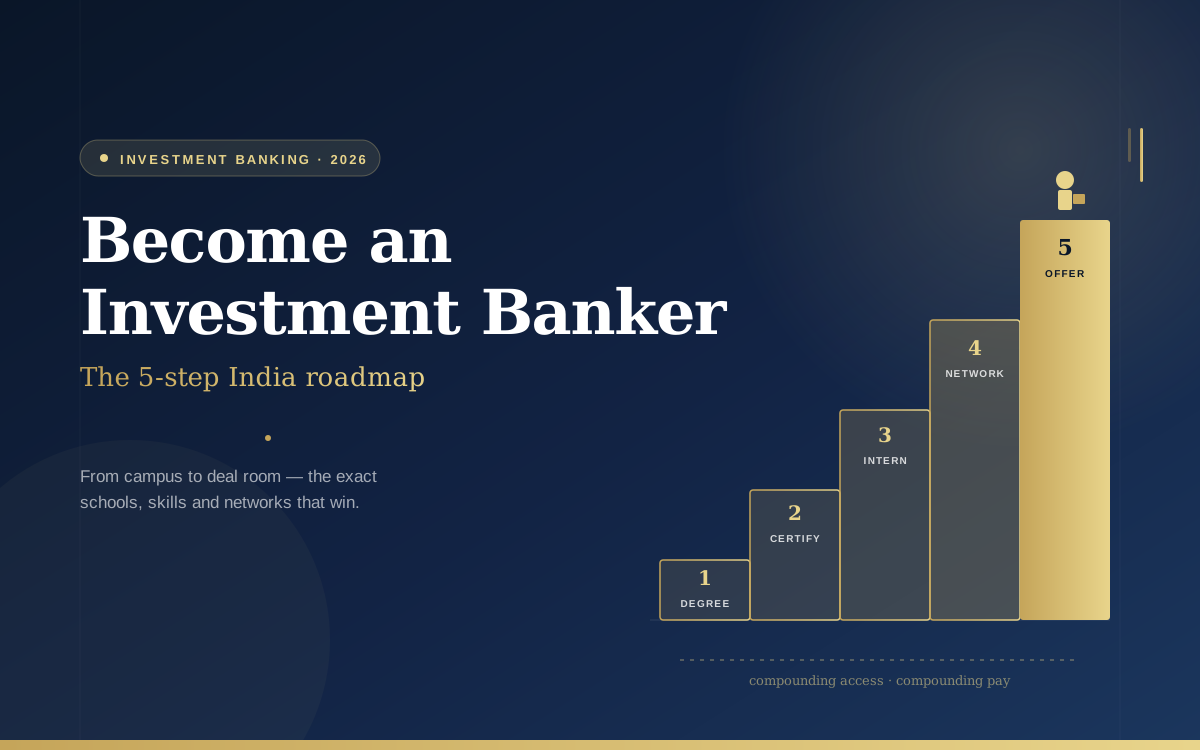
How to Become an Investment Banker in India: Your Complete 5-Step Roadmap
Investment banking remains one of the most coveted career paths in Indian finance. With deal values crossing $80 billion annually and India emerging as a global M&A hotspot, the demand for skilled investment bankers has never been higher. But the path to landing that coveted analyst or associate role can feel opaque and intimidating.
Whether you are a college student planning your career, a CA looking to transition, or a working professional eyeing a lateral move, this guide breaks down exactly how to become an investment banker in India — step by step, with realistic timelines and salary expectations for 2026.
Key Takeaway
Becoming an investment banker in India typically requires 2-4 years of focused preparation. The formula is straightforward: strong academics + technical skills (financial modeling, valuation) + relevant certifications + strategic networking. There is no single "right" path — campus placements, lateral moves, and CA-to-IB transitions all work if you build the right skill set.
Step 1: Build the Right Educational Foundation
Your educational background forms the first filter that recruiters apply. While investment banks do not mandate a specific degree, certain qualifications dramatically improve your odds.
Undergraduate Path
Most investment banking analysts in India hold degrees in one of three areas: commerce and accounting, engineering (particularly from IITs and NITs), or economics. A B.Com or BBA from a reputed university gives you domain knowledge, while an engineering degree signals quantitative strength that banks value highly.
Postgraduate Path
An MBA from a top-tier business school remains the most reliable route into investment banking. Campus placements at IIMs, ISB, XLRI, and similar institutions regularly produce IB hires at bulge-bracket and boutique firms alike.
Top Colleges for Investment Banking Placements in India
| Institution | Degree | IB Placement Rate | Top Recruiters |
|---|---|---|---|
| IIM Ahmedabad | MBA/PGP | High | Goldman Sachs, JP Morgan, Kotak IB |
| IIM Bangalore | MBA/PGP | High | Morgan Stanley, Citi, Avendus |
| ISB Hyderabad | PGP | High | Barclays, Nomura, Edelweiss |
| SRCC Delhi | B.Com (Hons) | Moderate | Lazard, Rothschild, ICICI Securities |
| IIT Bombay | B.Tech + MBA | Moderate | Goldman Sachs, Deutsche Bank, Axis Capital |
| XLRI Jamshedpur | MBA/BM | Moderate | JP Morgan, HSBC, JM Financial |
| NMIMS Mumbai | MBA | Moderate | Kotak IB, Motilal Oswal, SBI Caps |
If you are not at one of these institutions, do not be discouraged. Technical skill mastery and certifications can bridge the gap — which brings us to Step 2.
Step 2: Master the Core Technical Skills
Technical ability is the single biggest differentiator in investment banking recruitment. Banks test these skills rigorously during interviews through case studies, modeling tests, and technical questions. Here are the non-negotiable competencies you must develop.
Financial Modeling
Building integrated 3-statement financial models from scratch is the bread and butter of IB analyst work. You need to be comfortable projecting income statements, balance sheets, and cash flow statements — and linking them correctly so the model balances dynamically.
Valuation Techniques
Investment bankers use multiple valuation methodologies to arrive at a company's worth. The core methods you must master include Discounted Cash Flow (DCF) analysis, comparable company analysis (trading comps), precedent transaction analysis, and sum-of-the-parts valuation for conglomerates.
Advanced Excel & Presentation Skills
Excel is where investment bankers live. You need proficiency in keyboard shortcuts, advanced formulas (INDEX-MATCH, OFFSET, nested IFs), data tables, scenario analysis, and macro basics. Equally important is the ability to create polished pitch books and CIM documents in PowerPoint.
Accounting & Financial Statement Analysis
A deep understanding of GAAP and Ind AS accounting standards, along with the ability to normalise earnings, identify red flags in financial statements, and adjust for non-recurring items, is essential for any IB role.
Skills Importance in IB Interviews (Weighted Score)
Step 3: Get Certified to Stand Out
Certifications serve two purposes in investment banking: they validate your technical knowledge and signal serious commitment to the field. Here are the certifications that actually move the needle.
CFA (Chartered Financial Analyst)
The CFA charter is globally recognised and highly valued in IB. Even passing CFA Level 1 before your interviews demonstrates quantitative rigour. Many analysts at top banks are CFA charterholders or candidates. The full program takes 2-4 years to complete across three levels.
Financial Modeling & Valuation Certification
Dedicated IB-focused courses that teach practical financial modeling, valuation, and deal structuring give you hands-on skills that classroom education often lacks. These certifications are especially valuable for career switchers and candidates from non-target schools who need to demonstrate applied competence.
CA (Chartered Accountant)
For those already on the CA path, this qualification is a powerful entry point into investment banking. CAs bring deep accounting knowledge that banks need, and the CA-to-IB pipeline is well established at Indian firms like Kotak IB, Avendus, and JM Financial.
Other Helpful Certifications
NISM certifications (particularly Series VIII for equity derivatives) are useful for certain roles. An FRM (Financial Risk Manager) can help if you are interested in structured finance or risk-adjacent IB roles. CPA is valuable if you plan to work with US-focused deal teams.
| Certification | Time to Complete | Cost (Approx.) | IB Relevance |
|---|---|---|---|
| CFA (all 3 levels) | 2.5-4 years | $3,000-$5,000 | Very High |
| Financial Modeling Course | 2-4 months | $300-$800 | Very High |
| CA (ICAI) | 3-5 years | Moderate | High |
| FRM | 1-2 years | $1,500-$2,500 | Moderate |
| NISM Series VIII | 1-2 months | Minimal | Low-Moderate |
Step 4: Network Strategically & Build Your Profile
In investment banking, relationships often determine who gets the interview. Networking is not optional — it is a critical component of your job search strategy.
LinkedIn Outreach
Connect with IB professionals, alumni from your college working in banking, and recruiters at target firms. Send thoughtful messages that demonstrate genuine interest and knowledge of their work. Do not mass-send generic connection requests — quality outreach gets responses.
Alumni Networks
Your college alumni network is your most powerful tool. Alumni are more likely to refer you, take informational calls, and advocate for your candidacy internally. Tap into formal alumni associations, WhatsApp groups, and LinkedIn communities.
Industry Events & Conferences
Attend events hosted by CFA Society India, FICCI, industry seminars, and bank-sponsored workshops. These provide direct access to practitioners and hiring managers. Virtual events have made this easier than ever.
Internships & Pre-IB Experience
If you are still in college, pursue summer internships at investment banks, PE firms, or Big 4 transaction advisory teams. For lateral movers, experience in corporate finance, equity research, or management consulting translates well. Even a 2-month virtual internship at a boutique IB firm can significantly strengthen your candidacy.
Step 5: Crack the Application & Interview Process
With the right foundation, skills, credentials, and connections, you are ready to apply. Understanding how the process works at different entry points is crucial.
Entry Route 1: Campus Placements (MBA/Top UG)
This is the most structured path. Banks visit top campuses between September and February. The process typically involves resume shortlisting, a technical test or case study, two to three rounds of interviews (technical + fit), and a final round with senior bankers or MDs. Preparation should begin at least 3-4 months before placement season with intensive technical prep and mock interviews.
Entry Route 2: Lateral Hiring
For experienced professionals moving from equity research, Big 4, corporate finance, or consulting. Lateral hiring is less structured and relies heavily on networking and recruiter relationships. Expect a rigorous technical process including live modeling tests. Focus on highlighting transferable deal experience and sector expertise.
Entry Route 3: CA-to-IB Transition
Qualified CAs are actively recruited by Indian investment banks. The key is supplementing your accounting expertise with financial modeling and valuation skills. Many CAs join at the analyst or associate level at domestic banks before moving to larger platforms. Building a strong modeling portfolio and targeting firms with established CA hiring pipelines dramatically improves your chances.
Typical Timeline to First IB Role (Months)
Timeline assumes focused preparation with skill-building & networking running in parallel
Investment Banking Salary Expectations in India (2026)
Compensation in investment banking is significantly higher than most finance roles, but it varies widely based on the type of firm, location, and your experience level. Here is a realistic breakdown.
| Role | Experience | Bulge Bracket (Annual) | Domestic/Boutique (Annual) |
|---|---|---|---|
| Analyst | 0-3 years | 18-30 LPA | 8-18 LPA |
| Associate | 3-5 years | 30-50 LPA | 15-30 LPA |
| VP | 5-8 years | 50-80 LPA | 30-50 LPA |
| Director/ED | 8-12 years | 80-1.2 Cr | 50-80 LPA |
| Managing Director | 12+ years | 1.5-5+ Cr | 80 LPA-2 Cr |
These figures include base salary plus annual bonuses. Bulge-bracket banks (Goldman Sachs, JP Morgan, Morgan Stanley) pay at the top of the range and typically hire through campus placements at premier institutions. Domestic banks and boutique firms offer a wider range of compensation but often provide faster career progression and more deal exposure early on.
Key Takeaway
Do not choose your first IB role based solely on salary. Deal exposure, mentorship quality, and the brand name on your resume matter enormously for long-term career trajectory. A strong 2-3 year stint at a respected boutique can be more valuable than a back-office role at a bulge bracket.
Realistic Timeline: From Zero to IB Offer
Here is a practical month-by-month roadmap assuming you are starting from scratch with a relevant educational background.
Months 1-2: Foundation building. Enrol in a financial modeling and valuation course. Begin studying for CFA Level 1 if applicable. Start following deal news and building your understanding of the IB landscape in India.
Months 3-4: Skill deepening. Complete your modeling course with hands-on projects. Build 2-3 full financial models from scratch. Begin targeted LinkedIn outreach to IB professionals and alumni.
Months 5-6: Interview preparation. Practice technical questions daily — valuation, accounting, M&A concepts, and brain teasers. Attend mock interview sessions. Apply to internships or entry-level analyst positions at boutique firms for immediate opportunities.
Months 7-9: Active applications. Apply strategically to target firms through networking contacts, job portals, and direct applications. Prepare firm-specific pitches and stock pitches. Continue refining your technical skills based on interview feedback.
Months 9-12: Conversion and offer stage. Interview actively, negotiate offers, and secure your position. Use this period to also deepen sector expertise in an industry vertical that interests you.
Common Mistakes to Avoid
Focusing only on academics: A 9+ CGPA without modeling skills will not get you through IB technical rounds. Balance academic performance with practical skill-building.
Ignoring networking until application season: Start building relationships 6-12 months before you plan to apply. Warm introductions convert at 5-10x the rate of cold applications.
Applying too broadly without preparation: Sending 100 generic applications is less effective than sending 15 tailored applications backed by networking and strong technical preparation.
Underestimating the fit interview: Technical skills get you to the final round. Culture fit and your ability to articulate your motivation convincingly are what close the deal. Prepare your story — why IB, why this firm, why now.
Waiting for the perfect moment: There is no perfect time to start. Begin building skills and connections now, even if you are a year or two away from applying.
Frequently Asked Questions
At minimum, you need a bachelor's degree in commerce, economics, engineering, or a related field. An MBA from a top-tier institution (IIM, ISB, XLRI) significantly improves your chances through campus placements. Alternatively, a CA qualification combined with financial modeling skills is a well-established entry route. Beyond formal degrees, practical skills in financial modeling, valuation, and Excel are essential — these are tested rigorously during interviews.
The timeline depends on your starting point. MBA candidates at top campuses can land IB roles within 6 months of focused preparation during their program. Lateral movers from related fields like equity research or consulting typically need 9-12 months of targeted networking and skill-building. CAs transitioning to IB usually require 6-9 months of additional financial modeling training and networking. Starting completely from scratch with a relevant undergraduate degree, expect a 2-4 year journey including an MBA or equivalent experience.
CFA is not mandatory for investment banking, but it is highly valued. Even clearing CFA Level 1 demonstrates quantitative rigour and commitment to finance. It is particularly useful for candidates who do not come from target MBA programs, as it provides a credibility boost. That said, practical skills like financial modeling and valuation are more directly tested in IB interviews than CFA curriculum knowledge. The ideal approach is to pursue CFA alongside a hands-on modeling certification.
Absolutely. The CA-to-IB transition is one of the most well-trodden paths in Indian investment banking. CAs bring deep accounting and financial statement analysis skills that banks need. Many domestic investment banks like Kotak IB, Avendus, JM Financial, and Edelweiss actively hire CAs. The key is to supplement your CA qualification with financial modeling and valuation skills, as these are not covered in the CA curriculum. Building a portfolio of model projects and networking with IB professionals will accelerate the transition.
Starting salaries vary significantly based on the firm. Bulge-bracket banks (Goldman Sachs, JP Morgan, Morgan Stanley) offer analysts 18-30 LPA including bonuses. Domestic investment banks and boutique firms typically offer 8-18 LPA for entry-level analysts. Post-MBA associates at top firms can expect 30-50 LPA. Compensation grows rapidly — VPs with 5-8 years of experience can earn 50-80 LPA at bulge brackets. Bonuses form a significant portion of total compensation and are tied to deal performance.
Financial modeling is the single most tested skill — you should be able to build a 3-statement model and DCF from scratch. Valuation skills (DCF, comparable analysis, precedent transactions) are equally critical. Strong Excel proficiency with keyboard shortcuts and advanced formulas is expected. Beyond technical skills, you need a solid understanding of accounting, the ability to articulate M&A deal rationale, and strong communication skills for presenting in high-pressure situations. Fit questions around motivation and teamwork also carry significant weight.
Yes, an MBA is helpful but not the only path. CAs regularly break into IB without an MBA. Graduates from top undergraduate programs (SRCC, St. Stephen's, IITs) can enter through campus placements or off-campus applications. Professionals in equity research, Big 4 transaction advisory, or management consulting can make lateral moves based on relevant experience and technical skills. In all non-MBA paths, demonstrating financial modeling proficiency through certifications and project work becomes even more important to prove your readiness.
The top-tier firms in India include bulge brackets like Goldman Sachs, JP Morgan, and Morgan Stanley, which offer the highest compensation and global deal exposure. Among domestic banks, Kotak Investment Banking, Avendus Capital, JM Financial, and Axis Capital are highly regarded. Boutique advisory firms like Veda Corporate Advisors and Unitus Capital offer excellent deal exposure with smaller teams. The best bank for you depends on your career goals — bulge brackets offer brand prestige, while boutiques often provide faster learning curves and more client interaction at junior levels.