
Quick Verdict: ACCA vs CA in India (2026)
The ACCA vs CA debate divides Indian commerce students more sharply than almost any other career question. Both qualifications lead to high-paying careers in accounting, audit, and finance — yet they differ dramatically in pass rates, global mobility, duration, and the type of professional life they unlock.
The CA (Chartered Accountant), awarded by the Institute of Chartered Accountants of India (ICAI), is India's most prestigious accounting credential. It grants exclusive statutory audit rights, dominates the domestic accounting ecosystem, and is deeply woven into Indian tax, company, and regulatory law. However, its notoriously low pass rates and 4.5–6-year timeline deter thousands of students every year.
The ACCA (Association of Chartered Certified Accountants), headquartered in the UK with over 252,500 members across 180+ countries, offers a globally portable credential with significantly higher pass rates, flexible exam scheduling, and recognition by multinational employers from London to Dubai to Singapore. For Indian students who want international mobility without spending half a decade in articleship, ACCA has become a compelling alternative.
Key Takeaway
CA is the undisputed choice if you want to practise statutory audit in India, work in Indian taxation, or target CFO roles at traditional Indian corporations. ACCA is the stronger choice if you want global career options, faster qualification, and multinational employers — especially if you plan to work abroad or in India's booming GCC and MNC sector.
What Is ACCA and What Is CA?
Before comparing the two qualifications head to head, it helps to understand what each credential represents, who governs it, and how the programme is structured.
ACCA — Association of Chartered Certified Accountants
ACCA is one of the world's largest and fastest-growing professional accounting bodies, with 252,500+ members and 526,000+ students across 180+ countries. Founded in 1904 in the UK, it is regulated under a Royal Charter and recognised by governments, regulators, and employers worldwide.
The ACCA qualification comprises 13 papers across three levels: Applied Knowledge (3 papers), Applied Skills (6 papers), and Strategic Professional (4 papers, including 2 essentials and 2 options). Students must also complete an Ethics and Professional Skills module plus 36 months of Practical Experience Requirement (PER), which can be completed alongside or after exams.
ACCA exams are offered four times a year (March, June, September, December) at CBE centres across India, giving students significant scheduling flexibility. Graduates with relevant degrees can claim exemptions for up to 9 papers, fast-tracking the qualification to as few as 4–6 remaining exams.
CA — Chartered Accountant (India)
The CA qualification is awarded by the Institute of Chartered Accountants of India (ICAI), established under the Chartered Accountants Act, 1949. With over 400,000 qualified members, ICAI is one of the largest accounting bodies in the world and the sole authority for statutory audit practice in India.
The CA programme has three stages: Foundation (4 papers, after Class 12), Intermediate (8 papers across two groups), and Final (6 papers across two groups). Candidates must also complete 2.5 to 3 years of mandatory articleship training under a practising CA, which runs concurrently with exam preparation.
CA exams are offered twice a year (May and November), with limited attempts available before the next cycle. The CA Final examination is widely considered one of the toughest professional exams globally, with pass rates often falling below 10%.
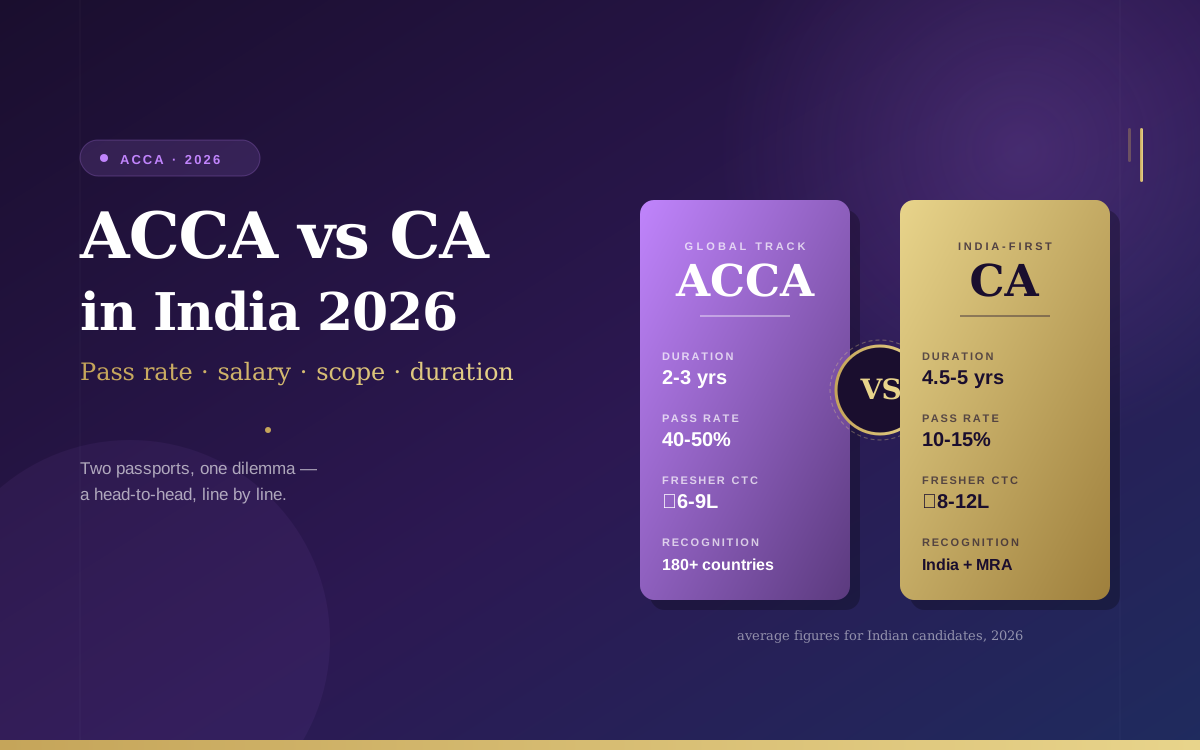
ACCA vs CA: Side-by-Side Comparison Table
The following table compares ACCA and CA across every critical parameter to help you make a well-informed decision.
| Parameter | ACCA | CA (ICAI) |
|---|---|---|
| Governing Body | ACCA (UK, Royal Charter) | ICAI (India, Act of Parliament) |
| Total Exams | 13 papers (exemptions possible for up to 9) | 18 papers across 3 stages (Foundation 4 + Intermediate 8 + Final 6) |
| Eligibility | Class 10+2 (full route) or graduation (exemption route) | Class 10+2 (Foundation) or graduation (Direct Entry to Intermediate) |
| Duration | 2–3 years (with exemptions); 3–4 years (full route) | 4.5–6 years (including 2.5–3 years mandatory articleship) |
| Pass Rates | 40–50% per paper (global average) | 3–9% for Final; 15–25% for Intermediate |
| Exam Frequency | 4 sessions per year (Mar, Jun, Sep, Dec) | 2 sessions per year (May, Nov) |
| Work Experience | 36 months PER (flexible, can be done alongside or after exams) | 2.5–3 years mandatory articleship (must be concurrent) |
| Total Cost (India) | INR 2–4 lakh (ACCA fees + coaching) | INR 1–2 lakh (ICAI fees + coaching; articleship stipend offsets cost) |
| Global Recognition | 180+ countries; MRAs with CA ANZ, CPA Canada, ICAEW, and others | Strong in India; limited international recognition without conversion exams |
| Statutory Audit Rights | No statutory audit rights in India; audit rights in UK, parts of Africa, Caribbean | Exclusive statutory audit rights in India |
| Curriculum Focus | IFRS-based, global standards, strategic management, business analysis | Indian GAAP, Indian tax law, Indian company law, cost accounting, audit |
| Difficulty Level | Moderate to high (challenging but achievable with consistent study) | Very high (one of the world's toughest professional exams) |
| Ideal Candidate | Students targeting MNCs, global Big 4, GCCs, or careers abroad | Students committed to Indian practice, statutory audit, domestic CFO track |
Pass Rates: ACCA vs CA — The Numbers Tell the Story
Pass rates are perhaps the single most decisive factor separating ACCA from CA. The difference is not marginal — it is dramatic and has profound implications for your career timeline and mental well-being.
ACCA Pass Rates (2024–2025 Data)
ACCA publishes transparent global pass rates for each paper after every examination session. Across the Applied Knowledge and Applied Skills levels, pass rates typically range from 50% to 75%. At the Strategic Professional level, pass rates are lower but still healthy, averaging 30% to 50% per paper. The overall weighted average across all 13 papers sits at approximately 40–50%.
This means that a well-prepared student who puts in consistent effort has a realistic probability of clearing papers on first attempt. Even Strategic Business Leader (SBL) and Strategic Business Reporting (SBR), the two toughest ACCA papers, have pass rates in the 45–50% range.
CA (ICAI) Pass Rates (2024–2025 Data)
The CA Final examination consistently records pass rates between 3% and 9% per attempt. The May 2024 CA Final Group 1 pass rate was approximately 7.8%, while Group 2 was around 8.3%. The CA Intermediate fares slightly better but still hovers at 15–25% per group. The CA Foundation, while comparatively easier, has pass rates of about 25–35%.
These figures mean that even among dedicated, full-time students, the overwhelming majority fail in any given attempt. Many CA aspirants take 3–5 attempts to clear the Final examination, pushing total qualification time to 6–8 years in practice.
Key Takeaway
The CA Final pass rate of 3–9% means that for every 100 students who sit the exam, only 3 to 9 pass. ACCA's 40–50% average means roughly half of well-prepared candidates succeed. This difference translates to years of additional study time and opportunity cost for many CA aspirants.
Salary Comparison: ACCA vs CA in India & Globally
Salary is often the tipping point in the ACCA vs CA decision. Both qualifications lead to strong earnings, but the trajectory, geography, and employer type vary significantly.
CA Salary in India (2026)
- Fresher CA (0–2 years): INR 7–12 LPA at Big 4 firms; INR 5–8 LPA at mid-size firms
- Mid-level CA (3–7 years): INR 12–25 LPA in corporate finance, audit, and taxation roles
- Senior CA / CFO track (8+ years): INR 25–60 LPA; CFOs at listed companies can exceed INR 1 crore
- CA in Practice: Revenue ranges from INR 5 LPA to INR 2 crore+ depending on client base and specialisation
ACCA Salary in India (2026)
- ACCA Affiliate (0–2 years): INR 6–10 LPA at MNCs, Big 4, and GCCs
- ACCA Member (3–7 years): INR 12–22 LPA in financial reporting, business analysis, and advisory roles
- Senior ACCA (8+ years): INR 22–45 LPA in finance controller, CFO, and regional head positions at MNCs
ACCA Salary Globally
- UK: GBP 35,000–70,000 (~INR 37–74 LPA) depending on seniority and city
- Middle East (UAE, Qatar, KSA): AED 150,000–400,000 (~INR 34–91 LPA)
- Singapore: SGD 50,000–110,000 (~INR 31–68 LPA)
- Canada & Australia: CAD/AUD 55,000–100,000 (~INR 34–55 LPA)
The salary data reveals an important nuance: CA holders edge ahead in India-centric senior roles (particularly CFO positions at domestic companies), but ACCA holders who leverage their global portability — by working in the UK, Gulf, or Singapore — often earn substantially more in absolute terms.
Global Scope & Career Mobility
This is where ACCA and CA diverge most dramatically. The global scope of each qualification defines the geography of your career.
ACCA: Built for Global Careers
ACCA is recognised in 180+ countries and has formal Mutual Recognition Agreements (MRAs) with leading accounting bodies including CPA Australia, CPA Canada, Chartered Accountants ANZ, ICAEW (England and Wales), and many others. This means ACCA members can convert their qualification to local credentials in multiple countries with minimal additional exams.
For Indian professionals, ACCA opens doors in the UK, UAE, Qatar, Saudi Arabia, Singapore, Malaysia, Hong Kong, Australia, Canada, and across Africa. Major employers like Deloitte, PwC, EY, KPMG, HSBC, Unilever, Shell, and Amazon actively recruit ACCA-qualified professionals for their global operations.
India's rapidly expanding Global Capability Centre (GCC) sector — with companies like JPMorgan, Goldman Sachs, Barclays, and Google setting up large finance teams — increasingly values ACCA for its IFRS expertise and international alignment.
CA: Dominant in India, Limited Abroad
The CA qualification is the gold standard within India, but its international recognition is limited. ICAI has MRAs with CPA Canada and ICAEW, allowing qualified CAs to obtain those credentials through conversion exams. However, in major markets like the USA, Australia, Singapore, and the Gulf, the CA (ICAI) does not carry automatic recognition, and professionals typically need to obtain local credentials separately.
CAs who move abroad often find that their Indian qualification is respected by employers for its rigour but does not grant them signing authority or regulatory standing in the new country. Many CAs working in the Gulf or Southeast Asia eventually pursue ACCA, CPA, or local equivalents to complement their CA.
Key Takeaway
If international career mobility is a priority, ACCA is the clear winner. Its recognition across 180+ countries and formal MRAs with major accounting bodies make it the most globally portable accounting credential available to Indian students. CA wins on domestic prestige and statutory rights but falls short on global transferability.
Duration & Difficulty: How Long Will It Take?
The time investment required for each qualification is starkly different, and this difference compounds when you factor in opportunity cost.
ACCA Duration
Students entering with exemptions (common for B.Com, BBA, or M.Com holders) can realistically complete ACCA in 2 to 3 years. Those starting from the Applied Knowledge level without exemptions typically need 3 to 4 years. The flexible exam structure — four windows per year and the ability to sit multiple papers per session — allows motivated students to accelerate their timeline.
The 36-month Practical Experience Requirement (PER) can run concurrently with exams, meaning it does not add extra time for students who start working early. Many Indian students complete their ACCA exams and PER simultaneously, qualifying fully by age 23–25.
CA Duration
The CA programme has a minimum duration of approximately 4.5 years from Foundation level. However, due to the low pass rates and only two exam windows per year, the practical average is 5 to 7 years for most students. Each failed attempt adds a minimum of 6 months to the timeline (the gap between exam windows).
The 2.5 to 3 years of mandatory articleship — which must be completed concurrently with exam preparation — is demanding. Students work 9–10 hours daily at CA firms while simultaneously studying for one of the world's hardest exams, a combination that contributes to the high failure rates.
Opportunity Cost Analysis
Consider two students who both start after completing their B.Com at age 21:
- ACCA Student: Qualifies by age 23–24 (with exemptions), starts earning a full salary of INR 6–10 LPA immediately, and has 3–4 years of professional experience by age 27.
- CA Student: Likely still clearing Final exams at age 25–27 (given average pass rates), earning only an articleship stipend of INR 2,000–5,000/month during that period. First full salary at age 26–28.
The cumulative opportunity cost — lost salary, delayed career progression, and the psychological toll of repeated failures — is a significant factor that many students underestimate when choosing CA.
Cost Comparison: ACCA vs CA
Cost is often cited as a CA advantage, but the picture is more complex when you consider total investment and earning potential.
| Cost Component | ACCA | CA (ICAI) |
|---|---|---|
| Registration Fee | GBP 79 (~INR 8,300) | INR 9,800 (Foundation) |
| Annual Subscription | GBP 122/year (~INR 12,800) | Minimal annual fees |
| Exam Fees (Total) | GBP 1,200–1,800 (~INR 1.26–1.89 lakh) | INR 30,000–50,000 (all stages) |
| Coaching Fees | INR 80,000–2.5 lakh | INR 60,000–2 lakh |
| Total Estimated Cost | INR 2–4 lakh | INR 1–2 lakh |
| Articleship Stipend Offset | Not applicable | INR 2,000–5,000/month for 2.5–3 years |
While CA has a lower sticker price, the total economic impact is different. ACCA students who qualify 2–3 years earlier start earning full professional salaries sooner. An ACCA student earning INR 8 LPA for 2–3 years while a CA peer is still in articleship represents INR 16–24 lakh in additional lifetime earnings — far outweighing the INR 1–2 lakh difference in qualification cost.
When ACCA Beats CA: 7 Scenarios
ACCA is the better choice in the following situations:
- You want to work abroad: If your goal is to build a career in the UK, Middle East, Singapore, Australia, or Canada, ACCA's global recognition and MRAs make it the most practical path.
- You want faster qualification: With exemptions, ACCA can be completed in 2–3 years compared to CA's 5–7 years in practice.
- You are targeting MNCs or GCCs in India: Companies like JPMorgan, Goldman Sachs, HSBC, Amazon, and Google value ACCA's IFRS-based curriculum for their India finance operations.
- You value exam flexibility: Four exam windows per year versus two means you can recover from setbacks quickly and plan your schedule around work or personal commitments.
- You want to avoid the articleship grind: ACCA's Practical Experience Requirement is flexible — you choose where you work, and it does not have to be at a CA firm paying minimal stipends.
- You are a working professional: ACCA's modular structure and flexible scheduling make it far more compatible with full-time employment than CA's rigid articleship requirements.
- You want IFRS expertise: ACCA's curriculum is built entirely on International Financial Reporting Standards, the global standard adopted by 140+ countries. Indian Accounting Standards (Ind AS) are converged with IFRS, making ACCA knowledge directly applicable in India as well.
When CA Beats ACCA: 5 Scenarios
CA remains the better choice in these situations:
- You want to practise statutory audit in India: Only a qualified CA can sign statutory audit reports in India under the Companies Act, 2013. ACCA does not grant this right.
- You want to specialise in Indian taxation: The CA curriculum covers Indian direct and indirect taxation in exceptional depth. If your career goal centres on Indian tax advisory, GST consulting, or appearing before Indian tribunals, CA is essential.
- You want maximum domestic prestige: In traditional Indian corporate circles, the CA designation carries unmatched recognition and respect. For roles at Indian conglomerates, government bodies, and traditional industries, CA opens more doors.
- You are confident about clearing the exams: If you have the academic aptitude and discipline to clear CA exams in 4.5–5 years, the long-term salary ceiling in India (CFO track, own practice) can be higher than ACCA.
- You want to start your own accounting practice in India: CA is a regulatory prerequisite for independent practice in statutory audit, attestation, and certain certification services in India.
Can You Do Both ACCA and CA? Is It Worth It?
Yes, pursuing both ACCA and CA is possible and increasingly common among ambitious Indian professionals. There are two primary approaches:
CA first, then ACCA: Qualified CAs can claim exemptions for up to 9 ACCA papers (the entire Applied Knowledge and Applied Skills levels), meaning they need to clear only 4 Strategic Professional papers. This can be achieved in 6–12 months of additional study, adding global recognition to an already powerful domestic credential.
ACCA first, then CA: This path is less common because ACCA does not grant significant exemptions from CA exams. However, ACCA members who decide to pursue CA will find that the conceptual knowledge overlaps substantially, particularly in financial reporting, audit, and strategic management.
The CA + ACCA dual qualification is particularly powerful for professionals targeting senior roles at Big 4 firms with international exposure, CFO positions at MNCs operating in India, or regional finance leadership roles in the Gulf or Southeast Asia. The combination signals both domestic rigour and global portability — a rare and highly valued profile in the market.
Career Paths: Where Each Qualification Leads
ACCA Career Paths
Corporate Finance: Financial analyst, management accountant, finance business partner, and financial controller roles at MNCs, GCCs, and global corporations.
Big 4 & Advisory: Audit associate, IFRS advisory, transaction advisory, forensic accounting, and risk consulting at Deloitte, PwC, EY, and KPMG.
Global Roles: Finance manager, group financial controller, regional CFO, and treasury roles across UK, Middle East, Singapore, and other ACCA-recognised markets.
Specialisation: IFRS reporting, sustainability reporting (ESG), data analytics in finance, fintech finance, and shared services leadership.
CA Career Paths
Statutory Audit & Assurance: Audit manager, partner-track roles at CA firms, and eventually setting up an independent audit practice.
Indian Taxation: Direct tax consultant, GST advisor, transfer pricing specialist, and appearance before Income Tax Appellate Tribunals and NCLT.
Corporate Leadership: CFO, VP Finance, and financial controller roles at Indian corporations, listed companies, and public sector undertakings.
Practice & Entrepreneurship: Own CA firm offering audit, tax, compliance, company incorporation, and advisory services to SMEs and corporates.
Statutory Rights & Legal Authority
One area where CA holds an absolute advantage over ACCA in India is statutory rights. Under the Companies Act, 2013, and the Chartered Accountants Act, 1949, only a member of ICAI holding a Certificate of Practice (CoP) can:
- Conduct statutory audits of Indian companies
- Sign audit reports and financial statements as a statutory auditor
- Issue certificates required by RBI, SEBI, and other Indian regulators
- Appear before Income Tax Appellate Tribunals and NCLT as an authorised representative
- Attest certain documents required under Indian tax and company law
ACCA does not grant any of these rights in India. If your career plan requires statutory audit authority or regulatory certification privileges in India, you must have a CA qualification. However, for the vast majority of finance and accounting roles in the corporate sector — financial reporting, management accounting, business advisory, controlling, and treasury — statutory audit rights are not required, and ACCA is equally or more valuable.
Frequently Asked Questions: ACCA vs CA
ACCA and CA are not legally equivalent in India. The CA (ICAI) holds exclusive statutory audit rights under Indian law, a privilege not extended to ACCA or any other foreign accounting body. However, in terms of professional competence, employer recognition at MNCs, and global career scope, ACCA is widely considered on par with or superior to CA for roles that do not require statutory audit authority. Both are rigorous professional qualifications, but they serve different career geographies and objectives.
By pass rate data alone, CA is significantly harder. The CA Final pass rate of 3–9% is among the lowest of any professional exam globally, compared to ACCA's 40–50% average. However, ACCA's Strategic Professional papers are by no means easy — they require deep analytical thinking, case study analysis, and professional-level written communication. The key difference is that ACCA exams are designed to be passed by competent, well-prepared candidates, whereas CA's difficulty often stems from the sheer volume of content, limited exam frequency, and the challenging conditions of concurrent articleship.
Absolutely. Many students who struggle with CA's low pass rates successfully transition to ACCA and thrive. Your CA study preparation is not wasted — there is significant overlap in financial reporting, auditing, and management accounting topics. Students who have cleared CA Intermediate may be eligible for exemptions from up to 9 ACCA papers, meaning they could potentially complete ACCA by clearing only 4 Strategic Professional papers. This is a common and practical pathway that thousands of Indian students take every year.
At the fresher level in India, CA holders have a slight edge (INR 7–12 LPA vs INR 6–10 LPA for ACCA) due to the credential's domestic prestige and the articleship experience. At mid-career and senior levels, salaries converge significantly, with both credentials commanding INR 15–25+ LPA. The real salary advantage for ACCA emerges when you factor in global opportunities: ACCA professionals working in the UK, Gulf, or Singapore can earn INR 35–90+ LPA. Within India, CA has the edge for CFO-track roles at domestic companies, while ACCA is preferred for MNC finance leadership.
Indian B.Com graduates from ACCA-accredited universities can receive exemptions for up to 5 papers (the 3 Applied Knowledge papers plus 2 Applied Skills papers, depending on their university and curriculum). M.Com graduates and CA Intermediate-cleared candidates may receive up to 9 exemptions. The exact number depends on your specific university, degree programme, and the modules covered. You can check your exemption eligibility on the ACCA website or through a QuintEdge career counsellor who can evaluate your academic transcripts.
Yes, ACCA is well-recognised by MNCs, Big 4 firms, GCCs, banks, and large Indian corporations with international operations. Companies like Deloitte, PwC, EY, KPMG, HSBC, JPMorgan, Goldman Sachs, Amazon, Google, Infosys, TCS, and Wipro actively hire ACCA-qualified professionals. However, traditional Indian companies that primarily need statutory audit or domestic compliance services may prefer CA holders. The recognition gap between ACCA and CA in India has narrowed significantly over the past decade as India's economy becomes more globally integrated.
You can pursue both, though doing them simultaneously is extremely demanding. The most practical approach is to complete CA first and then add ACCA, since qualified CAs receive exemptions for up to 9 ACCA papers and only need to clear 4 Strategic Professional papers (typically achievable in 6–12 months). Alternatively, some students pursue ACCA alongside their CA Intermediate preparation, leveraging the overlapping syllabus. The dual CA + ACCA qualification is particularly powerful for senior roles at Big 4 international desks, MNC CFO positions, and global finance leadership.
ACCA is the preferred qualification in the Gulf region (UAE, Qatar, Saudi Arabia, Bahrain, Oman, Kuwait). Most job postings for senior finance roles in the Middle East explicitly list ACCA as a requirement or strong preference. ACCA's IFRS-based curriculum aligns perfectly with the Gulf's adoption of International Financial Reporting Standards, and the credential is formally recognised by regulators in the UAE, Qatar, and other Gulf states. CA (ICAI) is respected for its rigour but does not carry the same regulatory recognition or employer preference in the region. If the Gulf is your target market, ACCA is the clear winner.