
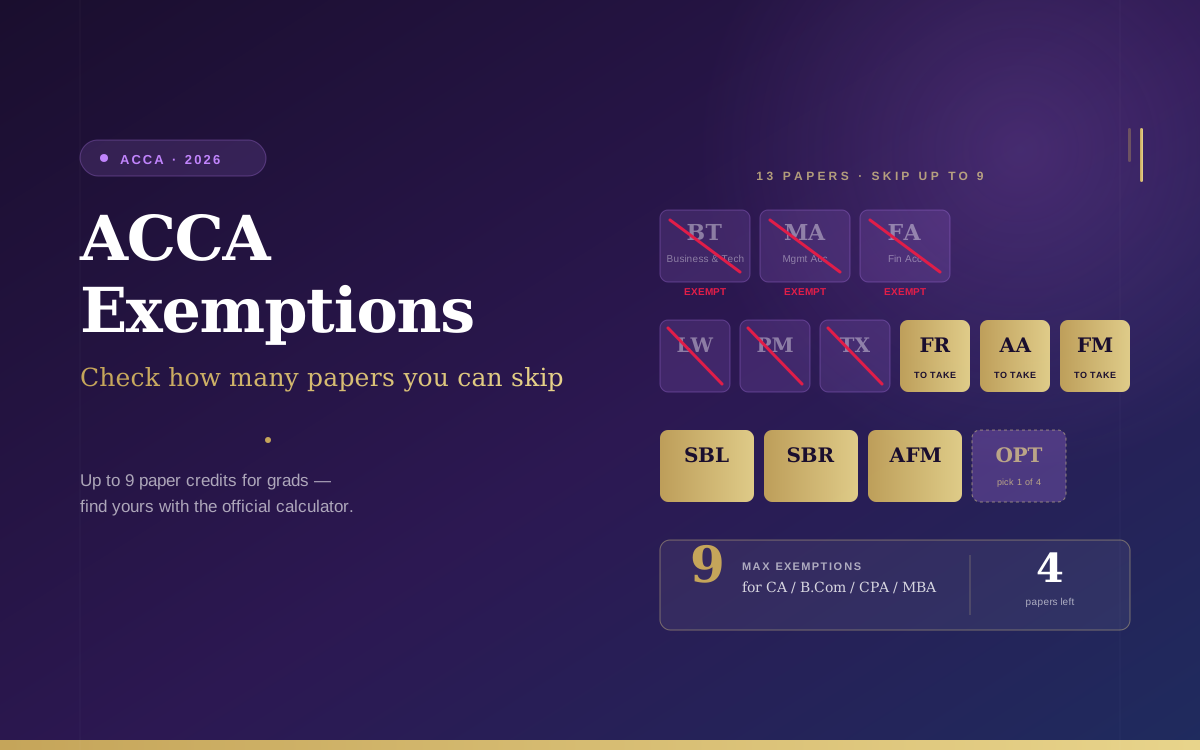
What Are ACCA Exemptions?
ACCA exemptions allow you to skip certain Applied Knowledge and Applied Skills papers if you already hold a relevant prior qualification. Instead of sitting every one of the 13 ACCA exams, you can claim credit for papers that overlap significantly with subjects you have already studied and passed.
The Association of Chartered Certified Accountants (ACCA) recognises that students entering with a degree in accounting, finance, or a related discipline — or with professional qualifications such as CA, CMA, or CPA — have already demonstrated competence in foundational areas. Granting exemptions removes duplication and lets you focus on the advanced subjects that genuinely add value to your career.
Exemptions are not automatic. You must apply through ACCA's online portal, submit supporting documents, and pay a fee per paper exempted. ACCA's Exemption Calculator on its official website gives an instant estimate, but this guide walks you through every major qualification in detail so you know exactly what to expect before you apply.
ACCA Exam Structure: A Quick Refresher
Before diving into exemptions, it helps to understand how the ACCA qualification is structured. There are 13 exams across three levels:
- Applied Knowledge (3 papers): Business and Technology (BT), Management Accounting (MA), Financial Accounting (FA)
- Applied Skills (6 papers): Corporate and Business Law (LW), Performance Management (PM), Taxation (TX), Financial Reporting (FR), Audit and Assurance (AA), Financial Management (FM)
- Strategic Professional (4 papers): Strategic Business Leader (SBL), Strategic Business Reporting (SBR), plus two Option papers from AFM, APM, ATX, AAA
Exemptions are available across the first nine papers only. The maximum number of exemptions any candidate can receive is nine — meaning you could, in theory, enter ACCA directly at the Strategic Professional level.
ACCA Exemptions by Qualification: Visual Overview
ACCA Exemptions by Qualification: Full Breakdown
B.Com (Bachelor of Commerce)
A standard B.Com degree from a recognised Indian university typically qualifies for up to 3 exemptions: BT, MA, and FA. These three Applied Knowledge papers align closely with the core subjects covered in most commerce undergraduate programmes — business studies, cost accounting, and financial accounting respectively.
However, not all B.Com programmes are equal. ACCA grants exemptions based on the specific syllabus of your university, not just the degree title. ACCA maintains an online Exemption Calculator where you can search for your institution and see exactly which papers are covered. If your university is not listed, you may need to submit a detailed transcript and syllabus for manual assessment.
| Paper | Paper Name | B.Com Exempt? |
|---|---|---|
| BT | Business and Technology | Yes (typically) |
| MA | Management Accounting | Yes (typically) |
| FA | Financial Accounting | Yes (typically) |
| LW onward | Applied Skills papers | No |
BBA (Bachelor of Business Administration)
BBA graduates generally receive the same set of exemptions as B.Com graduates — up to 3 papers at the Applied Knowledge level. The exact papers depend on the university's programme content. BBA programmes with a finance or accounting specialisation may occasionally qualify for one or two Applied Skills exemptions, but this is rare and highly institution-dependent.
BAF (Bachelor of Accounting and Finance)
BAF is one of the strongest undergraduate qualifications for ACCA exemptions. Offered primarily by Mumbai University, the BAF programme has a detailed overlap with ACCA's syllabus that ACCA formally recognises. BAF graduates typically receive up to 5 exemptions: all three Applied Knowledge papers (BT, MA, FA) plus two Applied Skills papers — LW and FR.
This makes BAF one of the most efficient entry points into ACCA for Indian students. With five papers already credited, you only need to pass the remaining seven Applied Skills papers (PM, TX, AA, FM) and the four Strategic Professional papers to complete the full qualification.
| Paper | Paper Name | BAF Exempt? |
|---|---|---|
| BT | Business and Technology | Yes |
| MA | Management Accounting | Yes |
| FA | Financial Accounting | Yes |
| LW | Corporate and Business Law | Yes |
| FR | Financial Reporting | Yes |
| PM, TX, AA, FM | Remaining Applied Skills | No |
M.Com (Master of Commerce)
M.Com holders typically receive 4 exemptions — the three Applied Knowledge papers plus one Applied Skills paper, most commonly FM or FR, depending on the university. M.Com programmes with a strong accounting and finance focus from recognised universities are more likely to receive the higher end of this range. As with undergraduate degrees, your specific institution matters greatly.
MBA (Finance Specialisation)
An MBA with a finance specialisation generally qualifies for 3 to 4 exemptions at the Applied Knowledge level, with some Applied Skills coverage possible depending on the programme. MBA programmes from AICTE-recognised institutions with strong finance curricula tend to score higher in ACCA's assessment. An MBA alone without a strong accounting base is unlikely to yield Applied Skills exemptions beyond FM.
CA Intermediate (ICAI)
Candidates who have cleared CA Intermediate (both groups) receive up to 5 exemptions: BT, MA, FA at the Applied Knowledge level, and TX and AA at the Applied Skills level. The alignment between CA Intermediate's taxation and audit papers with ACCA's TX and AA modules is particularly strong, which is why these two Applied Skills exemptions are consistently granted.
CA Final (ICAI)
A fully qualified Chartered Accountant (CA) who has cleared CA Final receives the maximum possible exemptions — all 9 Applied Knowledge and Applied Skills papers. This means a CA can enter ACCA directly at the Strategic Professional level and needs to pass only SBL, SBR, and two Option papers to earn the full ACCA qualification.
This is one of the most compelling pathways for Indian CAs looking to add a globally recognised credential. Four Strategic Professional papers — roughly 12 to 18 months of focused study — can unlock the ACCA designation and open doors to international finance roles across 180+ countries.
| Level | CA Final Exemptions | Papers Remaining |
|---|---|---|
| Applied Knowledge (3 papers) | All 3 exempted | 0 |
| Applied Skills (6 papers) | All 6 exempted | 0 |
| Strategic Professional (4 papers) | None — must sit all | 4 |
US CPA
Holders of the US Certified Public Accountant (CPA) credential typically receive the maximum 9 exemptions, entering ACCA at the Strategic Professional level. The US CPA is a rigorous qualification with significant overlap across all of ACCA's Applied Knowledge and Applied Skills domains, making the full exemption set highly justified.
US CMA and ICMAI CMA
The US CMA (IMA) qualification typically qualifies for up to 6 exemptions — all three Applied Knowledge papers and three Applied Skills papers: PM, FM, and one additional paper depending on assessment. The strong management accounting focus of the US CMA maps well to ACCA's performance and financial management modules.
The ICMAI CMA (Indian CMA, formerly ICWAI) at the Final level typically qualifies for up to 5 exemptions across the Applied Knowledge and some Applied Skills papers. The specific papers exempted depend on the level cleared (Foundation, Intermediate, or Final) and the ICMAI programme's assessed overlap.
Papers Remaining After Exemptions: How Close Are You?
ACCA Exemption Fees 2026
Exemptions are not free. ACCA charges a fee per paper exempted, and it is important to factor this into your decision before applying. As of 2026, the exemption fees are as follows:
| Paper Level | Exemption Fee (per paper) |
|---|---|
| Applied Knowledge (BT, MA, FA) | USD 89 (~INR 7,400) per paper |
| Applied Skills (LW, PM, TX, FR, AA, FM) | USD 119 (~INR 9,900) per paper |
For a CA Final or US CPA holder claiming all 9 exemptions, the total exemption cost would be approximately USD 267 (3 x USD 89) + USD 714 (6 x USD 119) = USD 981 (approximately INR 81,700). This is a significant upfront cost, and one of the reasons some candidates choose to sit the lower-level papers rather than claim exemptions — especially since those papers are also the easiest ones in the ACCA programme.
Pros and Cons of Claiming ACCA Exemptions
Exemptions sound like an obvious win, but they come with trade-offs that every candidate should consider carefully. Here is a balanced view:
Advantages of Claiming Exemptions
- Faster completion: Fewer papers to sit means a shorter path to the ACCA designation — potentially saving 1 to 2 years of study time.
- Cost savings on exam fees: Each ACCA exam costs between USD 131 and USD 262 depending on when you register and which sitting you choose. Skipping papers saves these fees.
- Focus on higher-level content: Rather than repeating material you already know well, you can invest your energy in the more challenging and career-relevant Strategic Professional papers.
- Employer perception: Entering at a higher level can signal strong prior credentials to recruiters, especially when the entry qualification (e.g., CA Final) is well-regarded in your target market.
Disadvantages of Claiming Exemptions
- Upfront exemption fees: As detailed above, claiming all available exemptions can cost close to USD 1,000 — sometimes exceeding the cost of sitting the actual exams at early-registration rates.
- Knowledge gaps: ACCA's Applied Skills papers, particularly FR (Financial Reporting under IFRS) and FM (Financial Management), have strong linkages to the Strategic Professional papers SBR and AFM respectively. Candidates who skip these via exemption sometimes find Strategic Professional content harder without that grounding.
- No ACCA transcript entry: Exempted papers are recorded as such on your ACCA transcript — they do not appear as passed exams. Some employers, particularly those hiring for ACCA-specific roles, may enquire about this.
- Lost practice opportunity: The lower-level papers are the best ones to build exam technique, time management, and comfort with the ACCA examination style. Skipping them means jumping straight into more demanding Strategic Professional conditions without that practice.
How to Apply for ACCA Exemptions: Step-by-Step
- Register with ACCA: You must first create an ACCA account and complete your student registration. Exemptions cannot be applied for before registration.
- Use the Exemptions Calculator: Visit ACCA's official website and use the Exemption Calculator. Enter your qualification details and institution to see which papers you may be eligible to claim.
- Gather supporting documents: You will typically need your degree certificate, official transcripts showing the subjects studied, and in some cases a detailed syllabus document from your institution.
- Submit your application: Log into your myACCA account, navigate to the Exemptions section, and submit your application with all supporting documents.
- Pay the exemption fees: Once your application is reviewed and approved, you will be prompted to pay the applicable fees per paper. Payment must be made within the deadline to secure the exemption.
- Receive confirmation: ACCA will confirm the granted exemptions via email and update your myACCA record. Your remaining exam requirements will be updated accordingly.
Processing times vary. Straightforward applications for listed institutions are typically processed within a few days. Applications requiring manual review of syllabi can take several weeks. Apply early to avoid delays affecting your exam registration timeline.