
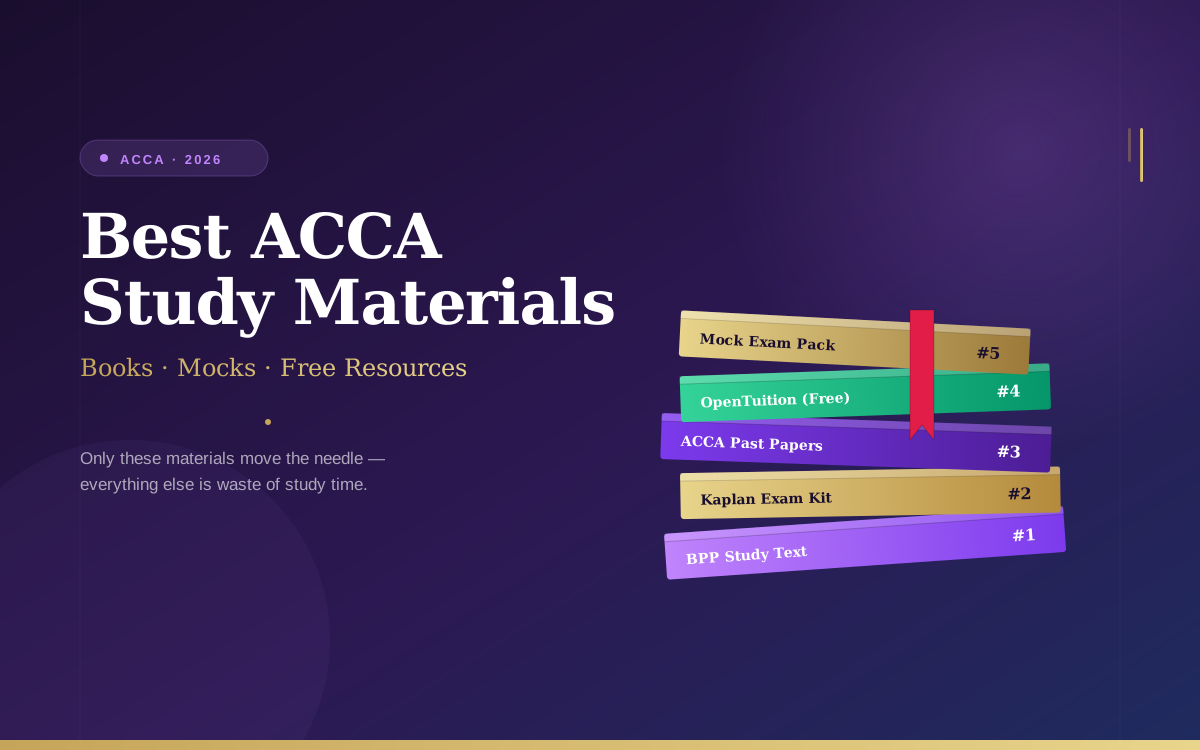
The ACCA Study Material Landscape in 2026
Choosing the right study materials is one of the most consequential decisions you will make on your ACCA journey. With pass rates hovering between 30% and 55% across most papers, the difference between clearing an exam and resitting often comes down to study material quality, revision strategy, and how well your resources align with the current ACCA Global syllabus.
The market for ACCA study materials has matured significantly. In 2026, candidates have access to a spectrum of options — from premium publisher packages costing upwards of ₹15,000 per paper to high-quality free resources that rival paid alternatives on specific papers. The challenge is not finding materials; it is knowing which combination actually works.
This guide cuts through the noise. We have ranked and reviewed every major study material category — approved publisher books, official ACCA resources, free online tools, mock exam providers, and paper-specific recommendations — so you can build the optimal study stack for your level and budget.
Approved Publishers
BPP and Kaplan are the only two publishers with full ACCA approval. Every other provider works from these as a baseline.
Official Resources
ACCA's own Practice Platform, past papers, and examiner reports are free and underused by most candidates.
Free Platforms
OpenTuition alone has helped hundreds of thousands of candidates pass Applied Knowledge and Applied Skills papers at zero cost.
Mock Exams
Attempting full mocks under timed conditions is the single highest-ROI activity in the final 3 weeks before any ACCA exam.
BPP vs Kaplan: The Head-to-Head Comparison
BPP and Kaplan have been the two ACCA-approved publishers for over two decades. Both are excellent — but they are not identical. Understanding their differences will help you choose the right fit for your learning style.
BPP is known for concise, exam-focused writing. Their Study Texts strip out unnecessary theory and front-load the content most likely to be tested. BPP's Practice and Revision Kits are particularly strong, with questions very closely calibrated to ACCA's marking schemes. Many tutors prefer BPP for Strategic Professional papers (SBL, SBR, AFM, APM) where application and judgment matter more than recall.
Kaplan takes a more expansive approach. Their Study Texts include more contextual explanation, worked examples, and conceptual scaffolding — making them better suited to candidates who need deeper understanding before attempting questions. Kaplan's PassCards (pocket-sized revision summaries) are a fan favourite for last-minute review, especially for Applied Skills papers like FM and PM.
| Criteria | BPP | Kaplan |
|---|---|---|
| Syllabus Coverage | ✅ Full — updated each session | ✅ Full — updated each session |
| Writing Style | Concise, exam-focused | Detailed, conceptual |
| Question Bank Quality | ⭐⭐⭐⭐⭐ Excellent | ⭐⭐⭐⭐ Very Good |
| Revision Kit | Practice & Revision Kit | Exam Practice Kit |
| Supplementary Tools | Digital Hub, eLearning | PassCards, OnDemand |
| Best For | Strategic Professional, exam technique | Applied Skills, concept building |
| Price per Paper (approx. INR) | ₹3,500 – ₹5,500 | ₹3,200 – ₹5,000 |
| India Availability | Amazon, Flipkart, direct | Amazon, Flipkart, direct |
| Digital Access | Yes (BPP Hub) | Yes (Kaplan Online) |
| ACCA Approved | ✅ Yes | ✅ Yes |
Study Material Cost Comparison (Per Paper, INR)
ACCA's Own Official Resources
Many candidates overlook the resources published directly by ACCA, which is a significant mistake. ACCA's official materials are free, authoritative, and directly aligned with what the examiners expect — because the examiners wrote them.
ACCA Practice Platform
The ACCA Practice Platform (available through your myACCA portal) hosts thousands of CBE-style practice questions across all Applied Knowledge and Applied Skills papers. The interface exactly mirrors the live exam environment, making it the best tool for building exam confidence and time management. Use it in the final 4–6 weeks before your exam date.
Past Exam Papers and Examiner Reports
ACCA publishes past papers and, crucially, Examiner Reports after every sitting. These reports are gold. They explain precisely where candidates went wrong, what the examiner was looking for, and common misconceptions. Reading the last 4–6 examiner reports for your paper before sitting is non-negotiable.
Technical Articles
For every paper, ACCA publishes Technical Articles on their website — detailed explanations of new examinable topics, common question areas, and syllabus updates. These are written by the examining team and should be read alongside your textbook for any paper you are studying.
Specimen Papers
Specimen papers show the format and question style for each paper in the current session format. They are essential reference points, especially after syllabus changes.
| Official ACCA Resource | Cost | Best Use | Recommended Timing |
|---|---|---|---|
| Practice Platform | Free (myACCA) | CBE practice, time management | Final 4–6 weeks |
| Past Papers | Free | Exam technique, question styles | Throughout study |
| Examiner Reports | Free | Understanding marking expectations | Before and after mocks |
| Technical Articles | Free | Syllabus updates, new topics | Early in study phase |
| Specimen Papers | Free | Format familiarisation | Start of revision |
| ACCA-X (edX) | Free (audit) / Paid (certificate) | Structured online learning for BT, MA, FA | Applied Knowledge only |
Free ACCA Resources: OpenTuition, YouTube & More
The free ACCA resource ecosystem has matured enormously. For Applied Knowledge papers in particular, free resources are now genuinely competitive with paid alternatives.
OpenTuition
OpenTuition is the most widely used free ACCA resource in the world, with over 2 million registered users. They offer free lecture notes, free video lectures (delivered by experienced ACCA tutors), and a large question bank. OpenTuition is particularly strong for:
- FA (Financial Accounting) and MA (Management Accounting) — their lecture series is comprehensive and well-paced
- FM (Financial Management) — arguably the best free FM resource available
- AA (Audit and Assurance) — excellent lecture notes and exam technique guidance
- SBR (Strategic Business Reporting) — strong for IFRS application questions
The one limitation of OpenTuition is that their question banks are smaller than BPP or Kaplan. We recommend using OpenTuition lectures + BPP or Kaplan Practice and Revision Kit for the best results.
YouTube Channels Worth Following
Several high-quality YouTube channels have emerged specifically for ACCA candidates:
- ACCA Official YouTube — webinar recordings, examiner interviews, and study technique videos
- Eduyush ACCA — India-focused tutorials with context for Indian candidates
- Mindmappers ACCA — excellent visual summaries for Strategic Professional papers
- Stephen Moulton — highly regarded for Applied Skills paper walkthroughs
ACCA Practice Hub and MyACCA
Beyond the Practice Platform mentioned earlier, ACCA's MyACCA portal provides access to study support, a performance dashboard tracking your exam history, and direct links to technical resources for each paper. Log in regularly — ACCA updates resources throughout the year, and technical articles are sometimes released just weeks before a sitting.
Pocket Notes and Summaries
For Indian candidates specifically, several coaching-affiliated summary note sets circulate on WhatsApp and Telegram groups. While convenient, verify that these are based on the current syllabus version before relying on them — outdated notes for papers like TX and ATX can actually mislead you on tax rates and legislation.
Mock Exams and Revision Kits: What Actually Works
If there is one study activity with disproportionately high impact on ACCA pass rates, it is attempting full mock exams under timed, exam-condition pressure. Candidates who complete at least two full mocks before sitting consistently outperform those who only practice individual questions.
Why Mocks Matter More Than Questions
Practice questions build knowledge. Mocks build performance under pressure. The ACCA CBE environment, the time constraints (particularly in Strategic Professional papers with 15-minute reading time), and the mental stamina required for a 3-hour professional-level exam are skills that only develop through simulation. Knowing the content is necessary but not sufficient.
Best Mock Exam Providers
- BPP Practice and Revision Kit — contains full mock exams with ACCA-style marking schemes. The closest available approximation to real exam questions. Essential for Applied Skills and Strategic Professional.
- Kaplan Exam Practice Kit — strong question bank with good variety. Some candidates use both BPP and Kaplan kits for maximum question exposure.
- ACCA Practice Platform — free, and mirrors the exact CBE interface. Best for timed question practice under live-exam conditions.
- Astranti — specialist provider for SBL mocks. Their SBL mock marking service (where a tutor marks and provides feedback on your responses) is particularly valuable for a paper where examiner technique is critical.
- MyPaperCoach — offers marked mock services for Applied Skills papers, useful if you want personalised feedback on long-form answers.
Revision Kit Strategy
Do not attempt to complete an entire revision kit question by question. A more effective approach:
- Complete the first 30–40% of questions as learning exercises — check answers after each question and understand every mark scheme point
- Complete the next 30% as timed practice — attempt under exam conditions, then review
- Use the final 30–40% as mock conditions — full timed sittings with self-marking
Provider Rating Overview
ACCA Study Material Provider Ratings (Out of 10)
Paper-by-Paper Recommendations
Not all papers require the same study material approach. Here is a paper-level breakdown across all three ACCA levels.
Applied Knowledge Papers (BT, MA, FA)
These are objective-test heavy papers where conceptual clarity and question practice volume matter most. The free route is genuinely viable here.
| Paper | Primary Resource | Secondary Resource | Notes |
|---|---|---|---|
| BT (Business and Technology) | BPP or Kaplan Study Text | OpenTuition Notes | High volume of OT questions needed; ACCA Practice Platform essential |
| MA (Management Accounting) | OpenTuition (Free) | BPP Kit for questions | OpenTuition lectures are excellent; buy only the kit, not the full textbook |
| FA (Financial Accounting) | OpenTuition (Free) | Kaplan Kit | Kaplan's worked examples are clearer for double-entry concepts |
Applied Skills Papers (LW, PM, TX, FR, AA, FM)
These papers are more demanding. A mix-and-match approach works well — use the textbook you find most readable for study, and ensure you use a full Practice and Revision Kit from either BPP or Kaplan.
- LW (Corporate and Business Law): Kaplan is preferred — their legal explanations are clearer. Supplement with past papers. For UK or GLO variants, verify your syllabus carefully.
- PM (Performance Management): BPP Study Text + OpenTuition lectures. PM has many calculation-heavy topics where OpenTuition's step-by-step approach excels.
- TX (Taxation): BPP only — their annual tax rates update is the most reliable. Kaplan is also solid. Never use notes more than one session old for TX.
- FR (Financial Reporting): Either publisher; supplement with ACCA technical articles on new IFRS standards. OpenTuition's FR notes are strong.
- AA (Audit and Assurance): BPP Study Text + OpenTuition for concepts. Examiner reports are critical for AA — read the last 4 reports before sitting.
- FM (Financial Management): OpenTuition is arguably the best FM resource available, free or paid. Supplement with BPP Kit for exam practice.
Strategic Professional Papers (SBL, SBR, AFM, APM, ATX, AAA)
At this level, understanding the examiner's mindset is as important as content knowledge. Written communication, professional scepticism, and integrated judgment across topics are what separate passing candidates.
- SBL (Strategic Business Leader): BPP is the preferred provider. Astranti's SBL mock marking service adds significant value. Read ACCA's SBL examiner guidance documents in full.
- SBR (Strategic Business Reporting): BPP or OpenTuition (both are excellent). Heavy focus on IFRS standards — ACCA technical articles are mandatory reading.
- AFM (Advanced Financial Management): BPP Study Text + extensive past paper practice. AFM has a predictable question rotation — analyse past papers carefully.
- APM (Advanced Performance Management): BPP Study Text. This paper rewards candidates who understand the 'so what' — practice explaining numbers in strategic context.
- ATX (Advanced Taxation): BPP only. Tax legislation changes annually; use only current-session materials.
- AAA (Advanced Audit and Assurance): BPP Kit + Kaplan Study Text combination. AAA rewards written quality — practice answer writing from week 1.
How to Effectively Use Your ACCA Study Materials
Owning the right study materials is only half the equation. How you use them determines your result. Here is a proven framework for Applied Skills and Strategic Professional papers.
Phase 1: Orientation (Week 1–2)
- Read the ACCA syllabus and study guide document (free on ACCA's website) to understand what is and is not examinable
- Read the most recent Examiner Report to understand where previous candidates lost marks
- Review the Specimen Paper to understand question formats
- Skim your textbook chapter headings to build a mental map
Phase 2: Study Phase (Weeks 3–10, varies by paper)
- Work through your chosen textbook systematically — do not skip chapters
- Attempt the chapter-end questions immediately after reading, without looking at solutions first
- Flag difficult concepts and watch the corresponding OpenTuition or publisher video
- Build a summary note for each topic as you go — writing forces understanding
Phase 3: Revision (Final 4–6 Weeks)
- Switch from reading to question practice as your primary activity
- Attempt full questions (30 marks for Applied Skills long-form, full past papers for Strategic Professional) under timed conditions
- Use ACCA Practice Platform for CBE question practice daily
- Complete at least 2 full mock exams in exam conditions
- Re-read examiner reports after each mock
Phase 4: Final Week
- Do not attempt new topics or read new content — consolidate only
- Review your summary notes and flagged questions
- Read technical articles for high-probability topics
- Get familiar with the exam centre environment or CBE interface
Indian Candidate-Specific Tips
For candidates studying in India, a few additional considerations apply:
- Budget planning: For a typical Applied Skills paper, budget ₹4,000–₹6,000 for a textbook + kit combination from one publisher. You do not need both BPP and Kaplan for the same paper.
- Edition awareness: Always check the edition year on books before purchasing. Some sellers on Amazon and Flipkart still stock prior-session editions. Confirm the book is for March/June 2026 or September/December 2026 sittings before buying.
- Coaching context: If you are attending ACCA coaching classes in India, confirm which publisher your coaching institute uses — your coach's teaching notes will be aligned to one publisher's structure.
- TX paper variant: Indian candidates typically sit TX-UK or TX-IND (Taxation — India). The India variant uses Indian tax legislation. Ensure your study materials specifically cover the India variant if you are sitting TX-IND.
Frequently Asked Questions
Yes. As of 2026, BPP and Kaplan are the only two publishers with full ACCA-Approved Content Provider status. This means their materials have been reviewed and verified by ACCA to ensure alignment with the current syllabus. Other providers such as Astranti and OpenTuition offer supplementary materials but are not approved publishers in the same formal sense. You can use supplementary resources freely, but your primary study text and revision kit should come from BPP or Kaplan.
For Applied Knowledge papers (BT, MA, FA), yes — many candidates pass using only OpenTuition notes, OpenTuition video lectures, and the ACCA Practice Platform. For Applied Skills papers, we recommend supplementing with at least a BPP or Kaplan Practice and Revision Kit, even if you use free lectures for study. OpenTuition's question banks are smaller than publisher kits, and question volume matters significantly at the Applied Skills level. For Strategic Professional papers, investing in a full publisher package is strongly recommended given the complexity and the high cost of resitting.
ACCA updates its syllabuses annually, and both BPP and Kaplan release new editions for every academic year (typically covering March–December sittings). For most papers, the changes between editions are minor, and using last year's edition is acceptable if you supplement with ACCA's technical articles and examiner guidance for the current session. However, for Taxation papers (TX, ATX), new editions are essential every year without exception, because tax legislation and rates change annually. Similarly, check for updates on any paper where you know there have been syllabus changes.
The Study Text and the Revision Kit (also called Practice and Revision Kit or Exam Practice Kit) serve entirely different purposes and should both be part of your study plan. The Study Text teaches you the content; the Revision Kit trains you to apply that content under exam conditions. If your budget requires a choice, prioritise the Revision Kit — you can substitute a free resource like OpenTuition for the study content, but there is no good free alternative to a comprehensive question bank with full worked solutions and marking schemes. Never attempt a live ACCA exam having only read a textbook without completing substantial question practice.
ACCA-X is a free (audit mode) online course on edX that covers the Applied Knowledge papers and some Applied Skills content. It is a solid option for candidates who prefer structured online learning with video explanations. However, it does not contain the depth of question practice needed to pass without additional resources. Think of ACCA-X as equivalent to a free video lecture series — valuable for concept building, but not a standalone exam preparation tool. Pair it with the ACCA Practice Platform and either OpenTuition notes or a publisher kit for the best outcome.
The minimum recommended is two full mock exams under timed, exam-condition settings. For Applied Knowledge papers, this means two full 2-hour CBE sittings using the ACCA Practice Platform in exam mode. For Applied Skills papers, complete two or three full paper-length mocks from your publisher's revision kit. For Strategic Professional papers, two full mocks is the minimum — ideally with written answer marking against the official mark scheme. Candidates who attempt more mocks consistently report higher confidence and better time management in the real exam. Quality of mock review (understanding every mark scheme point) matters more than the sheer number of mocks attempted.
If purchasing BPP or Kaplan Study Texts and Revision Kits for all 13 ACCA papers, the total materials cost in India is approximately ₹55,000–₹75,000 (roughly ₹4,000–₹5,500 per paper). However, most candidates reduce this significantly by: using free OpenTuition resources for Applied Knowledge papers (saving ₹15,000–₹20,000), buying only the Revision Kit (not the Study Text) for papers where they use free lectures, and buying second-hand books for non-taxation papers. A hybrid approach — free resources for Applied Knowledge, publisher kits for Applied Skills, full publisher packages for Strategic Professional — typically costs ₹25,000–₹35,000 in total, which represents excellent value relative to the career premium ACCA qualification carries.
Both formats have merits. Physical books are preferred by many candidates for deep study sessions — annotation, tabbing, and physical revision techniques are easier with print. Digital materials (BPP Hub, Kaplan Online) offer searchability, portability, and often include interactive features like progress tracking and integrated video. For the Revision Kit specifically, many candidates prefer digital formats because they can filter questions by topic, track completion, and access hints without accidentally seeing the full solution. Given that ACCA exams are computer-based, there is also an argument for practising in a digital environment throughout your studies. The best approach is to use physical textbooks for study and digital tools for question practice where possible.